
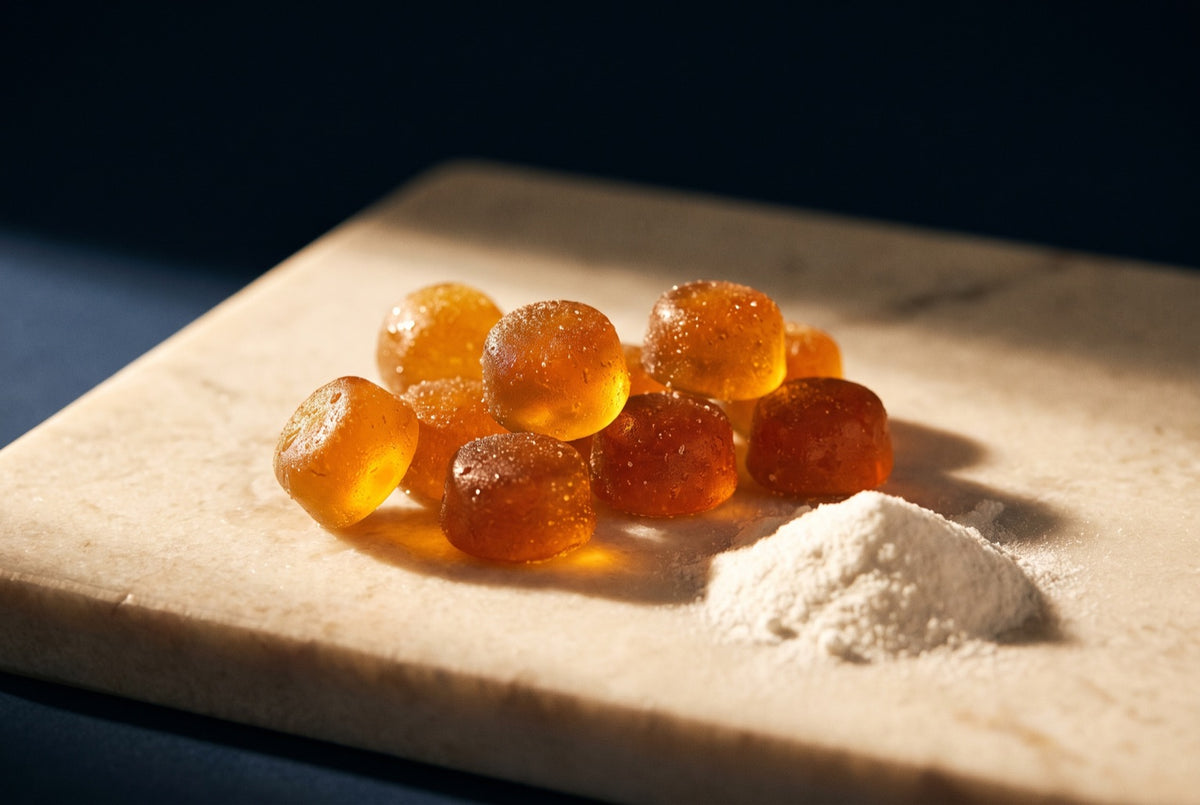
Creatine gummies can work, but only if every daily serving really delivers the 3–5 grams of creatine monohydrate that research uses. In the creatine gummies vs powder debate, the molecule is the same; what differs is how reliably each format gets that dose to you. Powder is the format behind most creatine research, it stays stable for years, and one level scoop is the whole dose. Gummies trade that simplicity for taste and portability, and they ask more of the label.
The supplement aisle can make this sound like a format war. It isn't one. Count the grams, check the testing, take it every day. Here's how to do all three, with the chemistry and the numbers behind each step.
The short answer
- Gummy or scoop, it can be the same creatine monohydrate. Results come from a steady 3–5 g a day.
- Powder is the format behind most creatine research, and dry creatine monohydrate showed no breakdown after more than 3 years in storage tests.
- Gummy making involves heat, water and often acid, the conditions that turn creatine into creatinine. Good formulas manage it; testing shows which ones do.
- In one 2024 industry test, 5 of 12 creatine gummy brands held little to no creatine. Check grams per serving and batch testing before you buy.
- A daily dose usually takes several gummies, plus their sugar or sweeteners. With powder, it's one scoop.
Do creatine gummies work as well as powder?
They can, because the active ingredient is the same. What matters is getting enough of it every day. Once your muscle creatine stores are full, the International Society of Sports Nutrition (ISSN) position stand says 3–5 g a day generally keeps them there, and larger athletes in hard training may need 5–10 g. The format is the delivery vehicle. The daily grams are what fill your muscles and drive what creatine monohydrate does.
Powder has the research head start. The NIH Office of Dietary Supplements (ODS) calls creatine monohydrate the most widely used and studied form of creatine, and the authors of the first gummy trial note that the majority of creatine research has used powder.
That gummy trial arrived in 2026. Pereira and colleagues randomized 32 female collegiate and professional beach volleyball athletes to 5 g a day of creatine monohydrate gummies (17 athletes) or no supplement (15 athletes) for 10 weeks. The creatine group improved countermovement jump height (p<0.001) and change-of-direction speed (p=0.009) compared with the controls, whose results held steady or slipped. Lean mass, skeletal muscle mass and reaction time did not differ between groups.
It's an encouraging first look. There was no powder group, so no study has yet compared gummies with powder head to head, but the authors report their gummy was independently verified to contain its labeled creatine: a verified 5 g gummy can do the job.
Why is creatine harder to keep stable in a gummy?
Dry creatine is tough. Wet creatine is not. In storage tests summarized in a 2011 review in Amino Acids (Jäger et al.), creatine monohydrate powder showed no sign of breakdown after more than 3 years at room temperature, or even at 40 °C (104 °F). In water, it's a different story. The ISSN position stand explains that dissolved creatine slowly cyclizes into creatinine, the same byproduct your body clears in urine, and that it happens faster the lower the pH and the higher the temperature. The stand calls this the main reason creatine is sold in solid form.
The numbers are steep. After 3 days in solution at 25 °C (77 °F), Jäger's review reports creatine losses of 4% at pH 5.5, 12% at pH 4.5 and 21% at pH 3.5. In a 2003 lab study of a creatine drink made from effervescent powder (Ganguly et al.), about 90% of the creatine had degraded within 45 days at room temperature, and about 80% even in the fridge.
Now picture how gummies are made. A 2023 review of gummy candy development in Foods describes the classic process: sugar and glucose syrup are heated with a gelling agent such as gelatin, poured into molds, then cooled and dried, and the finished gummies still hold roughly 15–30% water. Pectin, a popular vegan gelling agent, needs an acidic environment to set. Heat, water and acid are the three conditions creatine likes least.
That's a reason to check, not a verdict on every gummy. Skilled formulators can manage it, and in the industry test below, seven of 12 gummies met their label claims. It simply explains why, with gummies, the lab report matters as much as the label.
Do creatine gummies contain what the label says?
Not always. In March 2024, SupplySide Supplement Journal reported that supplement maker NOW Foods bought 12 creatine gummy brands on Amazon or from company websites and tested them. Seven met their label claims. Five contained little to no creatine, and all five showed creatinine, the breakdown product described above. A gummy with no measurable creatine is just candy with a creatine rumor.
That result comes from one company's testing and isn't peer reviewed. The 2026 trial authors raise the same concern, writing that creatine content and stability may vary substantially across commercial gummy products. Before you buy, check four things:
- Grams of creatine monohydrate per serving, stated as a number rather than folded into a blend.
- Gummies per serving, so you can work out how much each gummy holds.
- The creatine form. Monohydrate is the form behind the research.
- Batch testing. Look for third-party results for the lot you're buying, or a certificate of analysis on request. If it reports creatinine, lower is better.
How many gummies does it take to get 3–5 grams?
Usually more than one. In that test, the products that met their label claims split one serving across three to five gummies. Your own label is the only number that counts, so do the math:
- Divide the creatine per serving by the gummies per serving to get grams per gummy.
- Divide your daily target (3–5 g) by grams per gummy. That's your daily gummy count.
- Multiply the sugar, calories and any sugar alcohols per gummy by that count. A daily habit adds up over a month.
- Find the cost per gram: price ÷ (grams of creatine per serving × servings per container).
Watch for two traps. First, check whether the label lists grams of creatine monohydrate or grams of creatine. Monohydrate is 88% creatine by weight, so 5 g of creatine monohydrate supplies about 4.4 g of creatine. Compare like with like. Second, if you plan a loading phase, the ISSN protocol is about 5 g four times a day for 5–7 days, which multiplies your gummy count (and the sugar) by four for that week.
Powder skips the arithmetic: one measured scoop is one daily serving, and the dose is easy to adjust if your plan changes.
Creatine gummies vs. powder at a glance
| Factor | Creatine gummies | Creatine powder |
|---|---|---|
| Dose per serving | Varies by brand; one serving is often several gummies | One measured scoop; check grams per scoop on the label |
| Adjusting the dose | In whole-gummy steps | Easy to scale, including a loading week |
| Stability | Made with heat, water and often acid, the conditions that turn creatine into creatinine; formulation and testing matter | Dry creatine monohydrate showed no breakdown after more than 3 years in storage tests |
| Extra ingredients | Sugar or sweeteners, a gelling agent (gelatin or pectin), flavors, colors, often acids | Unflavored powders can be close to creatine alone; check the label |
| Research base | One 10-week trial in 32 athletes, without a placebo or powder group | The format behind most creatine research |
| What to verify | Grams per gummy, gummies per serving, batch testing, creatinine | Grams per scoop, servings per container, testing paperwork |
| Cost per gram | Price ÷ total grams of creatine; count servings carefully | Price ÷ (grams per scoop × servings) |
| Convenience | No mixing; easy to pack; tastes like candy | Needs a drink to mix into; unflavored powder blends into one you already have |
Which should you choose?
Pick the format you'll take every day, then make sure it delivers the dose.
- Choose gummies if mixing a drink is the thing that makes you skip creatine, or you want a no-prep option for travel. Buy one that states grams of creatine monohydrate per serving and backs it with batch testing, and plan on several gummies a day.
- Choose powder if you want the format most research used, the fewest extra ingredients, an easy dose to adjust and a simple cost per gram. One scoop a day and you're done.
Either way, consistency beats format. At 3–5 g a day, the ISSN notes that muscle creatine stores rise over about 3–4 weeks, so the daily habit is what pays off. Our guide to how long creatine takes to work walks through that timeline.
Infinite Labs Creatine Monohydrate: the simple scoop
If powder is your pick, Infinite Labs Creatine Monohydrate is a strong one. Each scoop delivers 5 g of creatine monohydrate, inside the 3–5 g daily range, and the container holds 60 servings. It's unflavored, made with creatine monohydrate plus silicon dioxide, a flow aid that keeps the powder from clumping. Stir it into water or a drink you already have, and follow the mixing and use directions on the container. No gummy count, no per-piece math: 60 servings × 5 g is 300 g of creatine monohydrate, so your cost per gram is simply the price divided by 300.
It's third-party tested and made in GMP-certified facilities, and certificates of analysis are available on request, the same paperwork this guide suggests looking for on any creatine. Allergen note: the label states that this product contains wheat.
Quick answers
Is it worth taking creatine gummies?
Yes, if the gummy you buy reliably delivers 3–5 g of creatine monohydrate a day and you'll actually take it. Check grams per serving, gummies per serving and batch testing first. If mixing a drink doesn't bother you, powder gets you the same daily dose with less to check.
What is the best form of creatine?
Creatine monohydrate. NIH ODS calls it the most widely used and studied form and says pricier alternatives, such as creatine ethyl ester and buffered creatine, have not been proven superior. Jäger's review found little to no evidence that newer forms are more effective or safer. Gummies aren't a different form, they're a delivery format; nearly all the gummies in that test listed monohydrate on the label.
Why did I gain weight after starting creatine?
Mostly water held in your muscles, not body fat. ODS reports that creatine often leads to weight gain because it increases water retention, with several studies finding a 1–2 kg (about 2–4 lb) rise in total body weight in a month during strength training. It happens with gummies and powder alike. For more on that, see how much water to drink on creatine.
The takeaway
Dose first, format second. Creatine gummies and powder can carry the same creatine monohydrate; the winner is whichever reliably puts 3–5 g in you every day.
- Hit the dose: 3–5 g of creatine monohydrate daily, in any format.
- Read the label: for gummies, check grams per serving, gummies per serving and batch testing before you buy.
- Stay consistent: daily use fills your muscle stores; the format just delivers it.
Sources
- Kreider et al. International Society of Sports Nutrition position stand: safety and efficacy of creatine supplementation. J Int Soc Sports Nutr. 2017.
- Pereira et al. Effects of creatine monohydrate gummies on performance and body composition in female beach volleyball athletes. J Funct Morphol Kinesiol. 2026.
- Jäger et al. Analysis of the efficacy, safety, and regulatory status of novel forms of creatine. Amino Acids. 2011.
- Ganguly et al. Evaluation of the stability of creatine in solution prepared from effervescent creatine formulations. AAPS PharmSciTech. 2003.
- Tarahi et al. Current innovations in the development of functional gummy candies. Foods. 2023.
- SupplySide Supplement Journal: NOW tests creatine gummies, finding almost half to be severely understrength. 2024 (trade press).
- NIH ODS: Dietary Supplements for Exercise and Athletic Performance (Health Professional).
Educational information, not medical advice. Infinite Labs Creatine Monohydrate is not intended to diagnose, treat, cure, or prevent any disease.

Keep it useful
Join the conversation