
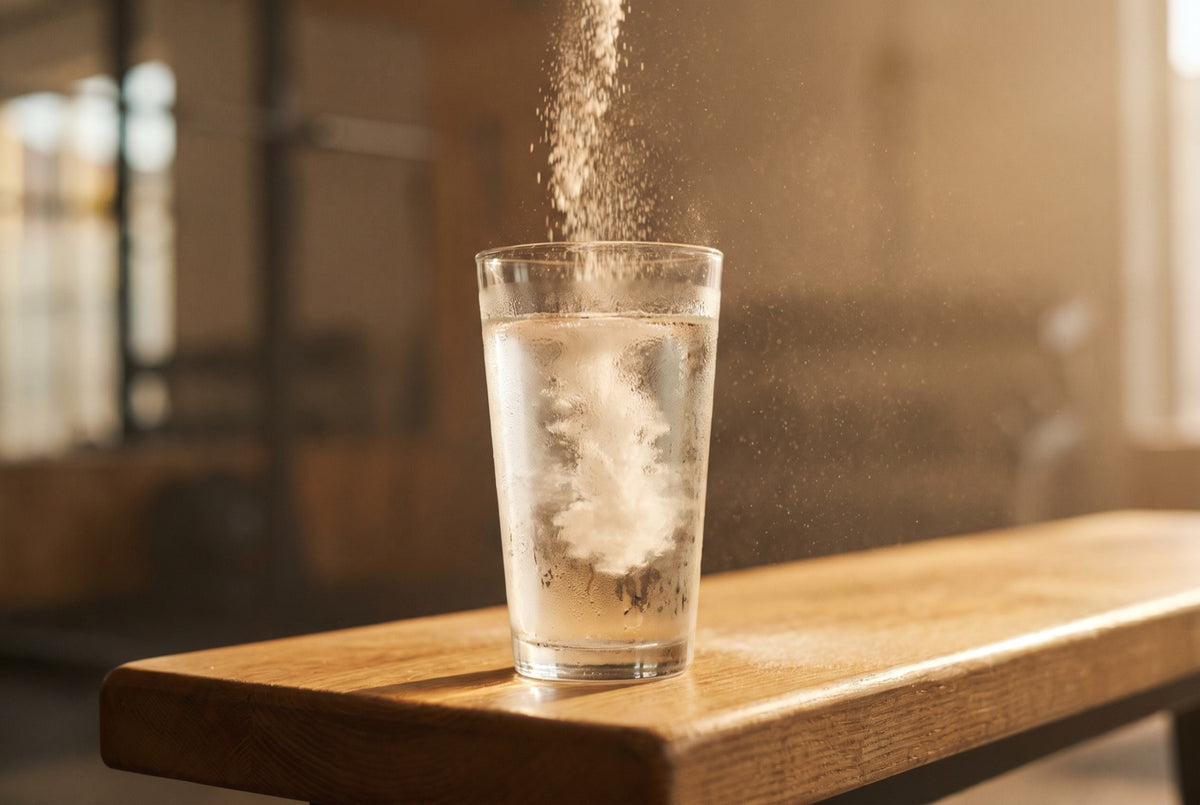
Creatine doesn't come with its own water target: drink what your body normally needs, add more when you sweat, and mix each 5 g scoop in about 12 oz (360 mL) of room-temperature water so it fully dissolves. For scale, the National Academies found that adequately hydrated women average about 2.7 liters (91 oz) of total water a day and men about 3.7 liters (125 oz), counting food as well as drinks. Most healthy people get there by letting thirst be their guide.
So where did "drink a gallon a day on creatine" come from? Supplement-aisle folklore, mostly. A gallon is about 3.8 liters from drinks alone, which already tops the men's average from food and drinks combined. Nothing in the creatine research asks for it. What creatine does change is how much water your muscles hold, and how much fluid a scoop needs to dissolve. Both are easy to handle once you see the numbers.
The short answer
- There is no creatine-specific daily water number. Meet normal needs: about 2.7 L for women and 3.7 L for men of total water on average, from food and drinks, with thirst as the guide.
- Drink more when you sweat hard or train in heat. Weighing yourself before and after a session shows how much you lost.
- Mix each 5 g scoop in about 12 oz (360 mL) of room-temperature water. Fridge-cold water needs more; a warm drink needs less.
- Early weight gain of 1 to 3 kg during a loading week is mostly water stored in muscle, and controlled studies have not found that creatine dehydrates you.
How much water should you drink on creatine?
Drink the amount you would need without creatine, then adjust for sweat and heat. Researchers have not set a separate daily water target for creatine users, and the controlled trials on hydration (covered below) have not turned up a reason to.
The best yardstick is the general one. In its report on water and electrolytes, the Institute of Medicine of the National Academies set adequate intakes from national data: about 2.7 liters of total water a day for women and 3.7 liters for men. About 80% of that comes from water and other beverages, caffeinated drinks included, and about 20% from food. The panel offered no glasses-per-day rule of thumb and said very active people and those in hot climates may need more.
| Adults | Total water, food and drinks | From drinks (about 80%) | From food (about 20%) |
|---|---|---|---|
| Women | About 2.7 L (91 oz) | About 2.2 L (73 oz) | About 0.5 L (18 oz) |
| Men | About 3.7 L (125 oz) | About 3.0 L (100 oz) | About 0.7 L (25 oz) |
These are averages for people who were already well hydrated, not minimums you must hit to the ounce. The only creatine-specific water is the fluid you mix each scoop into, and that counts toward your daily total like any other drink.
One exception: if you have kidney disease, heart failure or a prescribed fluid limit, your clinician's fluid plan comes first and general targets do not apply.
Why creatine and water get linked
Creatine brings water into your muscles with it. An expert evidence review in the Journal of the International Society of Sports Nutrition (Antonio et al., 2021) reports that a loading week of about 20 g a day typically raises body mass by 1 to 3 kg, mostly from water retention. That short-term water gain is largely inside muscle cells, and longer studies are mixed on whether it lasts. If you're new to the supplement, start with what creatine monohydrate does in your muscles.
The popular worry is that creatine "steals" water from the rest of your body. A 28-day randomized, placebo-controlled trial in 32 resistance-trained adults (16 men, 16 women) measured exactly that. The creatine group took 25 g a day for 7 days, then 5 g a day for 21 days. Muscle creatine, body mass and total body water all went up, and the split of water inside and outside cells did not change. More water on board, same distribution.
The NIH Office of Dietary Supplements notes that creatine often adds weight through water retention and possibly muscle protein synthesis, and that studies of strength-training programs report about 1 to 2 kg in a month. The water part is water you are holding, not water you have lost. The same fact sheet notes that adequate hydration while taking creatine might help minimize uncommon, anecdotal complaints such as cramps, which is one more reason to keep drinking normally rather than chasing a special number.
How much water to mix with one scoop
About 12 oz (360 mL) of room-temperature water fully dissolves a 5 g scoop. Temperature changes the answer a lot. A 2011 review of creatine forms in the journal Amino Acids (Jäger et al.) lists the solubility of creatine monohydrate: one liter of water dissolves 6 g at 4 °C, 14 g at 20 °C, 34 g at 50 °C and 45 g at 60 °C. Scale those down to a single 5 g scoop and you get the volumes below.
| Water temperature | Creatine dissolved per liter | Fluid to fully dissolve 5 g |
|---|---|---|
| Fridge-cold, 4 °C (39 °F) | 6 g | About 830 mL (28 oz) |
| Room temperature, 20 °C (68 °F) | 14 g | About 360 mL (12 oz) |
| Warm, 50 °C (122 °F) | 34 g | About 150 mL (5 oz) |
That explains the gritty sludge at the bottom of an ice-cold shaker. You would need nearly a quart of fridge-cold water to dissolve one scoop completely, while a mug-sized warm drink does it easily.
Don't sweat a few undissolved grains, though. The 2021 JISSN review states that solubility has no influence on tissue uptake. Sediment is a texture issue, not a wasted dose. Swirl the last sip and finish it so you get the full 5 g.
Drink it soon after mixing. Creatine powder is stable, but in water it slowly converts to creatinine, faster when the drink is warm or acidic. Jäger's review reports that after 3 days at 25 °C, 4% had degraded at pH 5.5, 12% at pH 4.5 and 21% at pH 3.5. Mix it, drink it, done. Skip pre-mixing a week of shakes in juice.
Do you need more water during a loading phase?
No separate water number exists for loading either, but loading adds mixing fluid on its own. The same 2021 JISSN review describes the usual protocol as 20 to 25 g a day for 5 to 7 days, often split into four or five 5 g servings. At about 360 mL per room-temperature serving, four servings come to roughly 1.4 liters (48 oz) of mixing fluid a day, and five come to about 1.8 liters (60 oz). That fluid counts toward your daily total.
Expect the scale to move. The same review puts the loading-week gain at 1 to 3 kg (about 2 to 7 lb), mostly water. That comes with creatine filling your muscles; it isn't a sign you are running dry. If you are still deciding whether to load at all, our guide to the creatine loading phase compares it with a steady daily dose. And if several scoops a day leave your stomach unhappy, does creatine make you poop covers the gut side.
Training in heat: hydration matters, creatine or not
Heat and hard training are what move your water needs. The scoop doesn't. The American College of Sports Medicine position stand on exercise and fluid replacement recommends starting exercise well hydrated and drinking enough during exercise to prevent more than a 2% loss of body weight from water deficit. Sweat rates vary widely between people, so the stand recommends a customized plan, and you can estimate your own sweat rate by weighing yourself before and after exercise.
Here is the math for an 80 kg (176 lb) lifter. A 2% loss is 1.6 kg (about 3.5 lb). Because a liter of water weighs about a kilogram, each kilogram you are down after a session is roughly a liter of fluid you didn't replace. The ACSM stand also notes that drinks with electrolytes and carbohydrates can offer benefits over plain water in some circumstances.
Creatine itself has been tested in the heat. A 2009 systematic review of 10 controlled trials found no evidence that creatine hinders the body's ability to shed heat or upsets fluid balance, and controlled trials of athletes exercising in the heat showed no adverse effects at recommended doses. The 2021 JISSN review adds a study of college football players in which creatine users had fewer cramps, heat illnesses and cases of dehydration than non-users.
Quick answers
Is 64 oz (about 2 liters) a day enough on creatine?
It can be, and creatine doesn't change the answer. 64 oz is about 1.9 liters, and food supplies roughly another fifth of your total water on top of what you drink. For comparison, the National Academies figures work out to about 2.2 liters (73 oz) from drinks for adequately hydrated women and about 3 liters (100 oz) for men, as averages. Let thirst guide you, and drink more when you sweat or it's hot.
Why did I gain weight after starting creatine?
Mostly water stored in your muscles. The NIH notes that during a strength-training program, creatine can add about 1 to 2 kg (about 2 to 4 lb) in a month, from water retention and possibly muscle protein synthesis, and loading can add 1 to 3 kg (about 2 to 7 lb). If the scale jumped well past that range, look at changes in your food and training too.
Does creatine dehydrate you?
Not in controlled studies at recommended doses: the 10-trial review above found no harm to fluid balance or heat tolerance. For the full side-effects picture, read is creatine safe.
Mixing Infinite Labs Creatine Monohydrate
Infinite Labs Creatine Monohydrate is an unflavored powder with 5 g per scoop and 60 servings per container, the same 5 g amount used in every calculation above. Creatine monohydrate is the form used in the body-water trial covered earlier, and the unflavored powder goes into water or another drink you already have. If you want a simple daily scoop that fits every mixing tip in this guide, it's a strong pick.
- Add one 5 g scoop to about 12 oz (360 mL) of room-temperature water, or to a smaller warm drink.
- Stir or shake until it looks clear, then swirl in any last grains.
- Drink it soon after mixing.
- Follow the container directions for your serving and routine.
Allergen note: the label states that this product contains wheat. Want to see the testing paperwork? Certificates of analysis are available on request.
The takeaway
Creatine doesn't need a gallon jug. Drink to your normal daily needs, about 2.7 liters of total water for women and 3.7 liters for men on average, with thirst as your guide. Add more when you sweat or train in heat, and weigh in before and after hard sessions if you want a real number. Give each 5 g scoop about 12 oz of room-temperature water, or a smaller warm drink, and drink it soon after mixing. If a clinician has set you a fluid limit, follow that plan instead.
Sources
- National Academies: Report sets dietary intake levels for water, salt, and potassium. 2004.
- American College of Sports Medicine; Sawka et al. Exercise and fluid replacement (position stand). 2007.
- Jäger et al. Novel forms of creatine: efficacy, safety and regulatory status. Amino Acids. 2011.
- Antonio et al. Common questions and misconceptions about creatine supplementation. J Int Soc Sports Nutr. 2021.
- Powers et al. Creatine supplementation increases total body water without altering fluid distribution. J Athl Train. 2003.
- Lopez et al. Does creatine supplementation hinder exercise heat tolerance or hydration status? J Athl Train. 2009.
- NIH ODS: Dietary Supplements for Exercise and Athletic Performance (Health Professional).
Educational information, not medical advice. Infinite Labs Creatine Monohydrate is not intended to diagnose, treat, cure, or prevent any disease.
Keep it useful
Join the conversation