
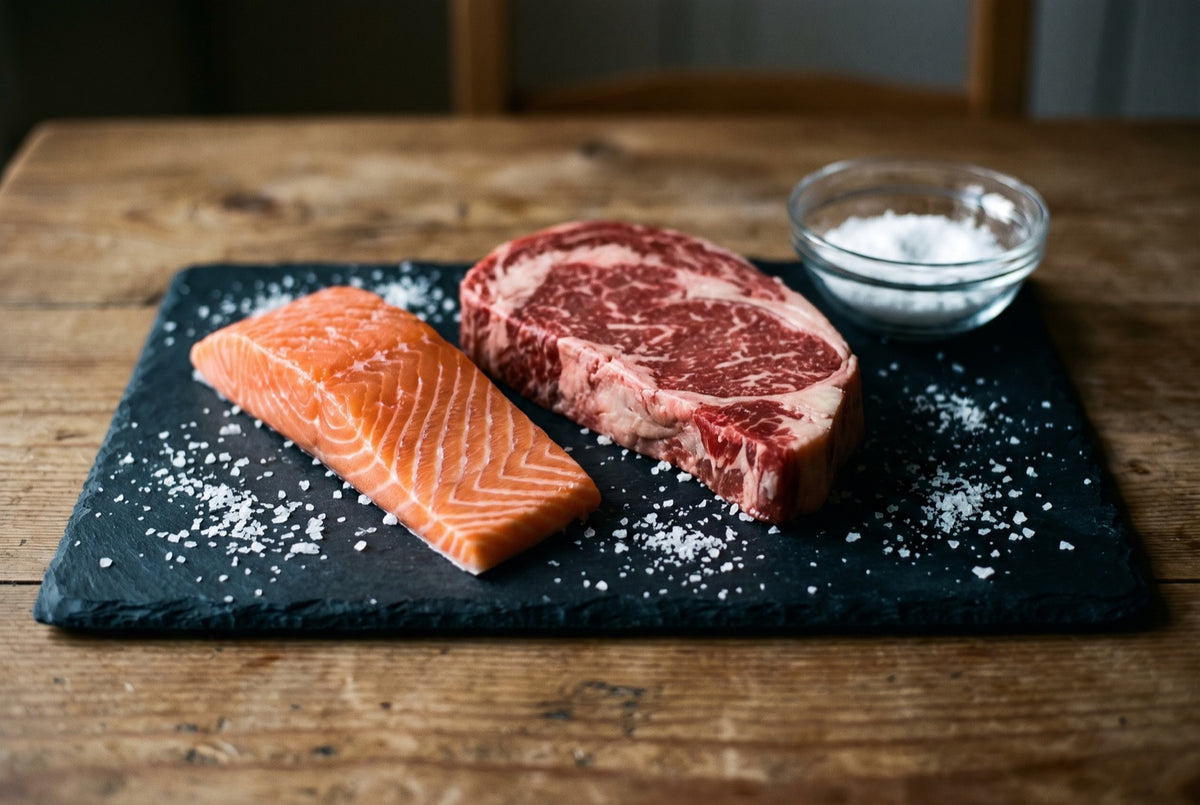
Creatine comes from three places: your own body, the animal foods you eat and, if you use a supplement, a chemical process that builds it from raw materials. So where does creatine come from on a normal day?
Your liver and kidneys make about 1 g, meat and fish add more, and supplement-grade creatine monohydrate is made by chemical synthesis rather than extracted from animals. That matters if you eat plant-based, because a vegan diet supplies almost no creatine from food.
The short answer
- Your body makes about 1 g a day, meat and fish supply roughly 2 g per pound, and supplements are made by chemical synthesis into the identical molecule.
- Dairy adds very little creatine, and plant foods are not a meaningful source.
- Vegetarians start with lower muscle creatine and, in trials, gained more muscle creatine than meat eaters when supplementing.
- For a vegan product, read the whole label: certification, capsule or gummy base, flavors and the allergen statement.
Where does creatine come from?
Three sources fill the tank, and each works differently.
- Your body. The liver and kidneys build creatine from three amino acids, glycine, arginine and methionine, according to the NIH Office of Dietary Supplements (ODS).
- Your plate. Animal foods such as beef, pork and salmon contain creatine, per ODS; the food table below has the amounts.
- A scoop. Supplement creatine is made by chemical synthesis. One ingredient maker's GRAS notice filed with the FDA describes building creatine monohydrate from two raw materials, cyanamide and sodium sarcosinate.
Wherever it starts, creatine ends up in the same place: muscle. A 154-lb person carries about 120 g of creatine and phosphocreatine, almost all of it in skeletal and heart muscle (ODS), and the International Society of Sports Nutrition (ISSN) position stand puts about 95% in skeletal muscle.
There it helps regenerate ATP, the fast energy your muscles spend during short, hard efforts. That is what creatine does in muscle in a nutshell.
How does your body make creatine?
In two enzyme steps, mainly in the liver and kidneys. The ISSN position stand lays out the assembly line:
- Build the base. An enzyme called AGAT joins arginine and glycine into guanidinoacetate.
- Finish the molecule. A second enzyme, GAMT, adds a methyl group from S-adenosylmethionine (the body makes it from methionine), and creatine is formed.
From there, about 95% of your creatine is stored in skeletal muscle as free creatine and phosphocreatine. About 1–2% of muscle creatine breaks down into creatinine each day and leaves in your urine.
That daily loss is why the tank needs topping up: ISSN estimates you must replace about 1–3 g a day, depending on muscle mass, and food usually covers part of it. Without meat and fish, that part shrinks, which helps explain why vegetarians start with lower muscle creatine.
What foods have creatine?
Meat and fish. Creatine is found primarily in red meat and seafood, according to the ISSN, with lamb and poultry in the same range. Eggs and dairy contribute very small amounts, and plant foods are not a meaningful source.
| Food | Creatine per pound (approx.) | Source |
|---|---|---|
| Pork | 2.3 g | NIH ODS |
| Lamb | 2.1 g (4.71 g per kg) | GRN 931 |
| Beef | 2 g | NIH ODS |
| Salmon | 2 g | NIH ODS |
| Poultry | 1.8 g (4.06 g per kg) | GRN 931 |
| Sausage | 1 g (2.18 g per kg) | GRN 931 |
| Ham | 0.9 g (1.91 g per kg) | GRN 931 |
| Liver | 0.06 g (0.13 g per kg) | GRN 931 |
| Dairy | 0.04 g (0.09 g per kg) | GRN 931 |
| Plant foods | Almost none reaches a vegan diet | Kaviani 2020 |
Now the real-world math. A 6-oz serving of meat holds about 0.7 g of creatine, according to a 2021 review in the Journal of the International Society of Sports Nutrition. The intake model in the GRN 931 notice estimates that Americans get about 0.4 g a day from food on average, and up to about 1.4 g for big fish eaters.
Liver is the plot twist: the organ that helps your body make creatine is one of the poorest meat sources of it. And a 5 g scoop of creatine monohydrate holds about 4.4 g of creatine, so matching it with food alone means roughly 2.2 pounds of beef, or about six 6-oz servings of meat. That is a lot of chewing for one day's dose.
How is creatine monohydrate made?
By chemical synthesis: think stainless steel reactor, not butcher. The FDA-hosted GRAS notice for Creapure, a creatine monohydrate ingredient made by AlzChem, states that creatine used in supplements is obtained from chemical synthesis and walks through the notifier's process:
- A water solution of sodium sarcosinate goes into a stainless steel reactor. Acid adjusts the pH, and the mix is heated above 70 °C.
- A cyanamide solution is added at that temperature, and creatine monohydrate crystallizes out of the solution.
- After cooling, the crystals are filtered, washed several times with potable water and dried under vacuum.
The finished molecule is structurally identical to the creatine found naturally in vertebrates, according to the notice, and supplemental creatine serves the same role in the body as the creatine you make. "Synthetic" describes the process, not a different substance.
"Monohydrate" means it crystallized with water attached, which is why creatine monohydrate is 88% creatine by weight: 5 g supplies about 4.4 g of creatine.
The notice caps the two by-products of this chemistry, creatinine and dicyandiamide, at 100 mg/kg and 50 mg/kg, with at least 99.9% creatine monohydrate. Other manufacturers can use different starting materials and routes, as the 2021 review notes, so this is one documented process, not a universal recipe.
Once made, creatine monohydrate goes into powders, capsules and gummies. If you are choosing between formats, our comparison of creatine gummies vs powder covers how each delivers a daily dose.
Is creatine vegan?
Creatine monohydrate is made without animal tissue in the documented process, so the ingredient itself can fit a vegan diet. Whether a particular product is vegan depends on everything else in the tub, capsule or gummy, and on how the brand verifies it.
Before you buy, check four things:
- A vegan claim or certification. It covers the whole finished product, not just the creatine.
- The capsule or gummy base. Capsule shells and gummies can be made with gelatin.
- Flavors, sweeteners and colors. Unflavored powders keep this list short.
- The allergen statement. Plant-based does not automatically mean free of wheat, soy or other allergens.
Infinite Labs Creatine Monohydrate keeps its ingredient list about as short as creatine gets: unflavored creatine monohydrate plus silicon dioxide, a flow aid that keeps the powder from clumping. The label states that it contains wheat, so skip it if you need to avoid wheat.
If certification matters to you, ask before you buy: certificates of analysis are available on request, and the same page takes certification questions.
Do vegans and vegetarians get more from creatine?
In muscle creatine, usually yes. In performance, the results are mixed. Vegetarians start lower, so they have more room to fill: ISSN reports vegetarian stores of 90–110 mmol/kg of dry muscle, and ODS notes they might respond more to supplementation than meat eaters.
| Study | Who and what | What changed |
|---|---|---|
| Burke et al., 2003 (randomized, double-blind) | 18 vegetarians and 24 non-vegetarians, ages 19–55, in 8 weeks of resistance training. Creatine dosed by lean mass (a 7-day load, then a lower daily dose) or placebo. | Baseline muscle total creatine was lower in vegetarians (117 vs 130 mmol/kg). Vegetarians taking creatine gained more total creatine, phosphocreatine, lean tissue and total work than non-vegetarians taking creatine. |
| Kaviani et al., 2020 (systematic review) | 9 studies in vegetarians, various doses. | Creatine raised muscle, blood and red-cell creatine, often to levels above omnivores'. Whether vegetarians gain more performance than omnivores was mixed. |
| Bonne et al., 2025 (randomized, double-blind) | 15 healthy young vegans and vegetarians (9 women, 6 men). 0.3 g/kg daily in four doses for 7 days (7 people), or placebo (8 people). | Muscle free creatine rose 18.8 and total creatine 30.8 mmol/kg; body mass rose 1.56 kg. Peak and mean power across four 15-second all-out sprints did not change. |
| López-Moreno et al., 2026 (randomized, triple-blind) | 20 physically active vegan adults, ages 18–45 (10 women, 10 men). 0.1 g/kg daily for 4 weeks, or placebo. | Versus placebo: skeletal muscle mass +0.3 kg, total body water +1.4 kg, body fat −1.4 kg. Countermovement and repeated-jump performance improved; sprint and strength tests did not change. |
The clear win is muscle creatine, which rose in both trials that measured it with muscle biopsies and across the studies in the 2020 review. Performance depends on the test: jumps improved over four weeks in the 2026 trial, while sprints held steady in both recent trials.
For a 154-lb (70 kg) adult, the 2026 dose of 0.1 g/kg works out to about 7 g a day.
Expect the scale to move, too. The weight gain in these trials fits ODS's description of weight gain as creatine's most consistent side effect, driven largely by water held in muscle. The 2026 trial enrolled 10 women and 10 men; for research specific to women, see creatine for women: benefits and what studies show.
Does creatine have calories?
Plain creatine adds essentially no usable calories. It is not a carbohydrate, fat or protein (the ISSN calls it a non-protein amino acid compound), and your body does not burn it for fuel the way it burns those. Your muscles use it to recharge ATP, and the creatine that breaks down each day becomes creatinine, which your kidneys eliminate.
For the number on any specific product, check the Supplement Facts panel: flavored powders and gummies can add sugar and calories. If you are asking because you fast, our guide to whether creatine breaks a fast walks through the answer by fasting goal.
Quick answers
Is a creatine supplement made from animals?
Not in the documented process: creatine monohydrate is synthesized from raw materials (GRN 931), not extracted from animal tissue. Other ingredients can still matter, so check the label and any vegan certification.
What are the main sources of creatine?
Your own body and animal foods, mainly meat and fish. Supplements are how people reach the 3–5 g daily maintenance amounts ODS describes.
Why do some doctors say no to creatine?
Usually because of the person, not the powder. ODS considers creatine safe for healthy adults, with evidence supporting several years of use. Caution comes in with existing kidney disease (the ISSN notes the suggestion that people with it consult a physician first), medicines that affect the kidneys, and blood work: a standard creatinine test uses creatinine to estimate kidney filtration, and serum creatinine rose with creatine in the 2026 vegan trial.
Tell whoever orders your labs that you take it. Our guides to creatine safety and side effects and to creatine, creatinine and kidney tests cover the details.
The takeaway
Your body and a meat-and-fish diet supply some creatine, and supplements deliver the same molecule in larger amounts. If you eat plant-based, food gives you almost none, so a supplement is the practical way to raise your stores; just run the vegan label check above before you choose one.
If you want a simple daily scoop, Infinite Labs Creatine Monohydrate is a strong pick: 5 g of creatine monohydrate per scoop, 60 servings and an unflavored powder that fits your preferred mixing routine. Follow the mixing directions on the container, and check the label's wheat allergen statement before you start.
Sources
- NIH Office of Dietary Supplements. Dietary Supplements for Exercise and Athletic Performance, health professional fact sheet.
- Kreider RB et al. International Society of Sports Nutrition position stand: safety and efficacy of creatine supplementation in exercise, sport, and medicine. J Int Soc Sports Nutr, 2017.
- AlzChem Trostberg GmbH. GRAS Notice GRN 931: Creatine monohydrate (Creapure). Submitted to the U.S. FDA, 2020.
- Antonio J et al. Common questions and misconceptions about creatine supplementation: what does the scientific evidence really show? J Int Soc Sports Nutr, 2021.
- Burke DG et al. Effect of creatine and weight training on muscle creatine and performance in vegetarians. Med Sci Sports Exerc, 2003.
- Kaviani M, Shaw K, Chilibeck PD. Benefits of creatine supplementation for vegetarians compared to omnivorous athletes: a systematic review. Int J Environ Res Public Health, 2020.
- Bonne TC et al. Muscle creatine levels and sprint performance in young adult vegans and vegetarians after 7 days of creatine monohydrate supplementation. Physiol Rep, 2025.
- López-Moreno M et al. Does creatine supplementation improve strength and power in physically active individuals on a vegan diet? A randomized, triple-blind, placebo-controlled trial. Eur J Appl Physiol, 2026.
- MedlinePlus. Creatinine Test. U.S. National Library of Medicine.
This article is educational and is not medical advice. Infinite Labs Creatine Monohydrate is not intended to diagnose, treat, cure, or prevent any disease.
About the author
Arjun Sareen is CEO of Infinite Labs and Infinite Labs Digital and a contributor to the Infinite Labs Journal. This brand-owned guide provides educational information, not individual medical advice.

Keep it useful
Join the conversation