
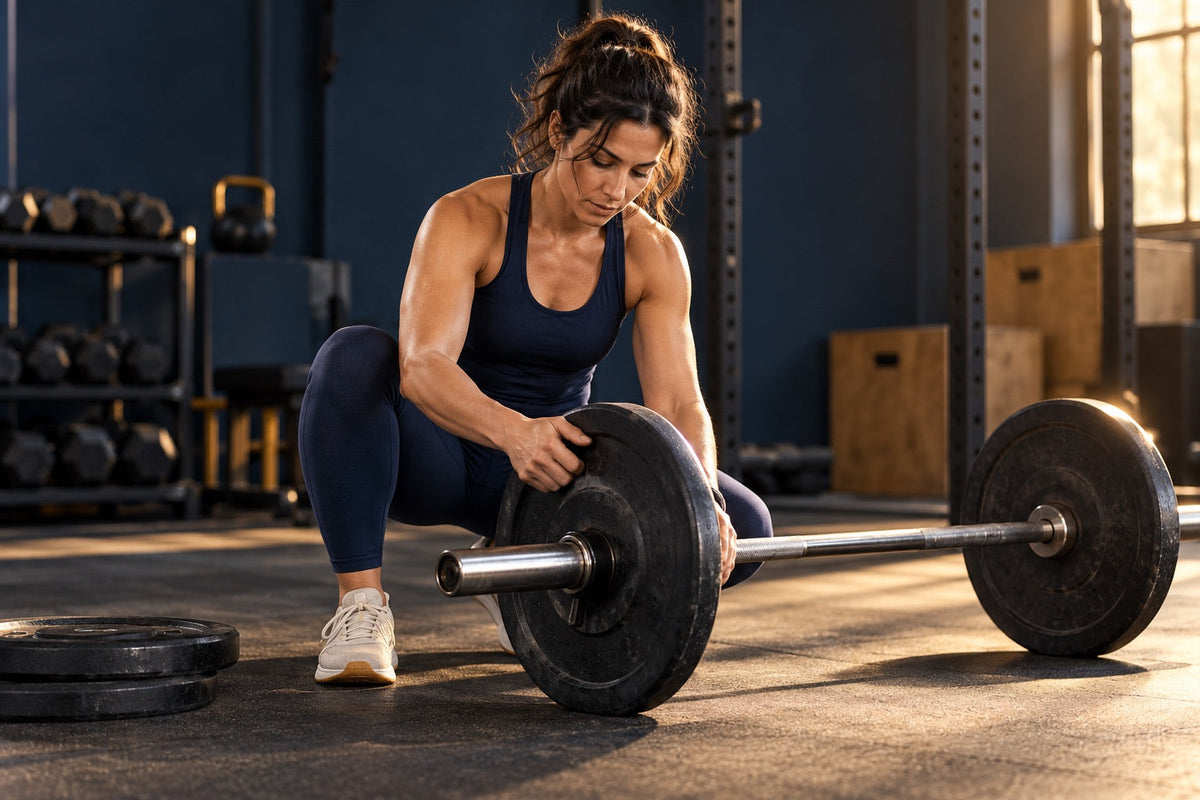
Women can benefit from creatine monohydrate, especially when training includes hard, repeated efforts. Creatine monohydrate is the same ingredient across adult products; women-specific studies help us understand how well the findings apply to different training goals. Some women-only trials show better strength or exercise capacity; a recent review of active women found mixed results overall. That is a useful starting point, not a reason to skip the subject.
Creatine helps rapidly regenerate the energy your muscles use during lifting, sprints, and other brief, intense work. It does not know your gender, but study design matters: women's training status, life stage, dose, and outcome measures have not always been examined well. Here is the evidence without pink powder mythology.
What does creatine do for women?
Your body makes creatine, and you also get some from animal foods. Much of it is stored in muscle as creatine and phosphocreatine. During short, hard efforts, phosphocreatine helps replenish ATP, the molecule that powers muscle contraction. Taking creatine monohydrate can increase muscle stores, which may let you perform a little more work in training. Over time, that extra capacity can support training adaptations.
The NIH Office of Dietary Supplements describes the strongest performance evidence for repeated high-intensity activity, with less value for pure endurance events. This applies to the ingredient across adults; the question is how confidently we can predict outcomes in particular groups of women.
What do women-only studies show?
A 1997 placebo-controlled study followed 19 young women through ten weeks of resistance training. After four days of 20 grams per day, muscle phosphocreatine was 6% higher. With 5 grams per day thereafter, gains in trained-muscle maximal strength were 20–25% greater in the creatine group than in placebo. That is a concrete result, and also a small, specific trial. It is not a guarantee that every woman will gain 25% more strength.
The broader picture is more cautious. A 2025 systematic review of 27 studies in active women concluded that results for sport and exercise performance were inconclusive overall. Study participants ranged from recreationally active women to athletes; dosing and tests differed substantially. A review can find encouraging individual trials and still conclude that the total evidence does not support one sweeping promise. Both facts can be true.
| Question | Evidence so far | Limit |
|---|---|---|
| Can it support strength training? | Some controlled women-only trials report added gains | Results vary; training remains the main driver |
| Does every active woman perform better? | 2025 review of 27 studies found mixed outcomes | Different sports, doses, and measures |
| Does it protect postmenopausal bone? | A large two-year trial did not improve its primary bone-density outcome | Other bone geometry measures changed, but clinical meaning is uncertain |
| Is it well tolerated? | Female-participant safety review found no significant pooled rise in adverse events | Reporting was incomplete and pregnancy was not established |
What about women over 50?
Creatine is often marketed as a solution to every change after menopause. The actual data deserve more respect. In a two-year randomized trial of 237 postmenopausal women, participants exercised and took creatine or placebo. Creatine did not improve the study's primary measure of femoral-neck bone mineral density. It also did not add a clear improvement in bench-press or hack-squat one-repetition maximum. The creatine group did improve its 80-meter walking time relative to placebo, and some bone-geometry measures differed.
That result rules out an easy “creatine builds bone after menopause” claim. It does not rule out every possible performance benefit in every older woman. Smaller trials and pooled analyses have suggested strength or lean-mass benefits under some protocols, but larger, well-designed studies may give different answers. If the goal is stronger muscles and bones, resistance exercise is still the foundation; creatine is a possible adjunct, not an insurance policy.
Will creatine make women bulky or gain fat?
Creatine can increase body weight because more water is held with muscle, especially during a loading phase. That early change is not the same as gaining fat, and it is not proof of new muscle tissue either. Body-composition instruments often classify water-containing tissue as lean mass, which is one reason short studies need careful interpretation.
As for “bulky,” meaningful muscle gain depends on progressive training, food, time, and individual response. One daily scoop cannot create a physique you did not train toward. If a sport requires a strict weigh-in, the possible water-weight shift may matter. If your goal is stronger lifts or better repeated efforts, weigh the performance upside against your own preferences rather than an old gym stereotype.
Are there side effects for women?
The practical side effects are similar to those discussed for adults generally: water-weight changes and, for some people, stomach discomfort. A systematic review of women in creatine studies found 29 studies that monitored adverse outcomes, covering 951 participants. It reported no deaths or serious adverse outcomes and no statistically significant pooled increase in total adverse events or gastrointestinal events. The confidence intervals were wide, and the authors called for better adverse-event reporting.
That is reassuring within the studied populations, not permission to claim creatine is safe in every situation. Pregnancy and breastfeeding need individual clinical advice because direct supplement-safety evidence is limited. The same goes for kidney disease, abnormal kidney tests, or medications that affect kidney function. Kidney-lab and hair-loss claims also need to be judged against the human evidence, not online certainty.
What about hormones, cycles, mood, and brain health?
These are interesting research questions, and they are where marketing most often sprints ahead of the data. Researchers have proposed that menstrual-cycle or menopause-related physiology could change creatine needs or responses. The ISSN's female-athlete position stand discusses these possibilities while noting that direct investigations are needed. A hypothesis is not a personalized dosing chart.
Brain and mood research is also developing, but this article does not treat creatine as a cure or treatment for depression, cognitive decline, or any other condition. Exercise performance is the clearer consumer use case today. If a brand claims one supplement will optimize your hormones, brain, bones, and squat by Friday, its confidence is doing most of the lifting.
How much creatine should women take?
Typical adult guidance is 3–5 grams of creatine monohydrate daily. There is no universally accepted “women's dose” separate from the usual adult maintenance range. Some studies use body-weight-based doses or a brief loading phase, so the exact protocol behind a result matters. A loading phase can raise muscle stores faster, but it is optional.
Take it consistently, including rest days. The main point is to build and maintain muscle creatine stores over weeks, not to find a mystical post-workout minute. Use the product's measured serving and reassess if it causes discomfort.
Quick answers
Is creatine good for women who do not lift?
The clearest performance evidence comes from short, intense or repeated exercise. Someone doing only steady endurance activity should expect less benefit. Other potential uses are under study, but a broad everyday-health promise would overstate the evidence.
Does creatine affect periods?
There is not enough direct evidence to say that standard creatine supplementation predictably changes menstrual cycles. Track a persistent or concerning change and discuss it with a clinician instead of attributing it to one supplement by default.
Can women take creatine every day?
In healthy adults who choose to use it, daily dosing is the standard approach. If you are pregnant, breastfeeding, have kidney disease, or have relevant medications or abnormal tests, ask your clinician first.
The takeaway
Creatine monohydrate is a reasonable option for women who want to support high-intensity training. Some women-only trials show gains; a recent review of active women finds the overall performance picture mixed. For a practical routine, choose a clear training goal, keep training consistently, and use a studied dose while accounting for the mixed women-specific findings.
The research above concerns creatine monohydrate as an ingredient. Explore Infinite Labs Creatine Monohydrate for a powder option alongside your training, and review its serving directions to build a routine that fits your goals.




Keep it useful
Join the conversation