
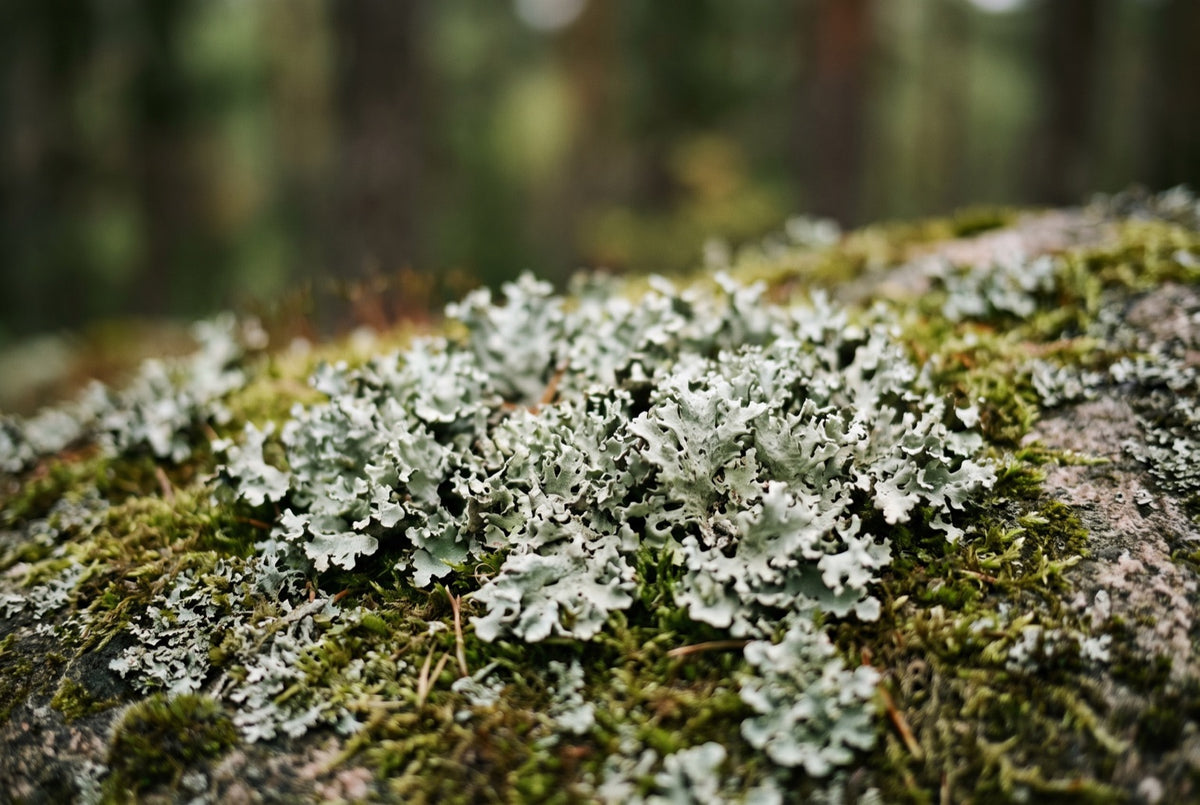
Vegan vitamin D3 is ordinary vitamin D3 (cholecalciferol) made from lichen instead of lanolin, the sheep's-wool source behind most D3 supplements. The vitamin is the same; only the starting material changes. Vegans have two animal-free options, lichen D3 or vitamin D2, and most evidence, per the NIH Office of Dietary Supplements, favors D3 for raising and holding blood vitamin D levels.
The label, or a quick question to the maker, tells you which one you are getting.
New to the pair? Start with what vitamin D3 and K2 do together. This guide covers where the D3 comes from.
The short answer
- Most vitamin D3 is made from lanolin in sheep's wool. Vegan D3 comes from lichen, and vitamin D2 (from yeast or UV-treated mushrooms) is vegan too.
- D3 generally raises blood vitamin D more than D2, including in a 12-week trial of daily 600 IU doses.
- In a UK study of 2,107 adults, vegans averaged 55.8 nmol/L of blood vitamin D versus 77.0 nmol/L in meat eaters, and the gap was wider in winter.
- Adults need 600 IU a day (800 IU over 70). The upper limit is 4,000 IU a day from all sources.
- Vitamin D is fat-soluble, so take it with a meal.
What makes vitamin D3 vegan?
The source. Vitamin D3 is vegan when its starting material is animal-free, which in practice means lichen. The NIH vitamin D fact sheet says supplement D3 is typically made from lanolin from sheep's wool, that "an animal-free version of vitamin D3 sourced from lichen is also available," and that people avoiding animal products can ask manufacturers about sourcing. Vitamin D2, made from yeast, is the other vegan option.
The vitamin is only part of the bottle. A vegan-friendly D3 supplement passes five checks:
- Source: "vitamin D3 (as cholecalciferol) from lichen", not just "vitamin D3".
- Capsule: a veggie capsule rather than gelatin.
- Carrier: a plant-derived oil or oil powder, such as coconut MCT oil.
- K2, if included: the form (MK-7 or MK-4) and the amount are stated.
- Straight answers: the brand answers sourcing questions and can share testing documents on request.
The front of the bottle sells. The ingredient panel tells.
Why isn't most vitamin D3 vegan?
Because of how it is made. Standard D3 production takes 7-dehydrocholesterol from lanolin, obtained from the wool of sheep, and irradiates it with UV light, the same reaction that makes D3 in your skin when UVB rays hit it. Wool comes from an animal, so lanolin D3 is off the list for vegans.
That is why "vegetarian" and "vegan" are not interchangeable on a vitamin D label: a product can swap gelatin for a veggie capsule and still contain lanolin D3. Fish liver oils, which NIH counts among the best natural food sources of vitamin D, are animal-derived too. How the common sources line up:
| Starting material | Vitamin D form | Animal-free? | Source |
|---|---|---|---|
| Lanolin from sheep's wool (UV-irradiated 7-dehydrocholesterol) | D3 | No | NIH ODS |
| Lichen | D3 | Yes | NIH ODS |
| Yeast (UV-irradiated ergosterol) | D2 | Yes | NIH ODS |
| UV-treated mushrooms | D2 | Yes | Bieg 2026 |
| Algae | D2, and D3 in some species; amounts vary with species and UV exposure | Yes, but not yet a validated vitamin D source | Bieg 2026 |
| Fish liver oils | Vitamin D (natural food source) | No | NIH ODS |
What is lichen vitamin D3?
Lichen vitamin D3 is cholecalciferol, the same vitamin D3 molecule, made from lichen instead of wool. Lichens are the crusty or leafy growths you see clinging to rocks and trees, and according to the U.S. Forest Service each one is a symbiotic partnership of a fungus and an alga (sometimes a blue-green "alga", which is actually cyanobacteria). No animal is involved, hence "vegan" or "plant-based" D3.
Same vitamin, different starting point. NIH simply lists lichen D3 as an animal-free version of vitamin D3. No published head-to-head human trial has compared lichen D3 with lanolin D3, so a label promising that its lichen D3 "works better" than regular D3 is selling a story, not a study.
The choice research does address is lichen D3 versus vitamin D2. On the label, look for wording such as "vitamin D3 (as cholecalciferol from lichen)"; if it only says "vitamin D3", ask the company before assuming it is vegan.
Vegan D3 vs D2: which raises vitamin D levels more?
D3, in most of the evidence. Both D2 (ergocalciferol) and D3 raise blood 25-hydroxyvitamin D, or 25(OH)D, the main marker of vitamin D status, but the NIH fact sheet says "most evidence indicates that vitamin D3 increases serum 25(OH)D levels to a greater extent and maintains these higher levels longer than vitamin D2."
The dosing pattern matters. A 2012 meta-analysis of randomized trials in adults by Tripkovic and colleagues found D3 raised 25(OH)D significantly more than D2 overall (P = 0.001). The advantage was clear with large, infrequent bolus doses (P = 0.0002), but the effect was lost with daily supplementation.
The same group then tested daily doses directly. In a 12-week randomized, double-blind, placebo-controlled trial, 335 healthy South Asian and white European women aged 20 to 64 in the UK were randomized to placebo or 15 mcg (600 IU) a day of D2 or D3 in fortified juice or biscuits through the winter.
Total 25(OH)D rose 15.3 to 16.9 nmol/L more in the D3 groups than in the D2 groups.
A 2026 narrative review by Bieg and colleagues points the same way: across multiple randomized trials, D2 raised its own form of the blood marker but frequently lowered the D3 form, and it was less effective than D3 at raising total 25(OH)D.
So D2 works and remains a reasonable vegan option, but D3 has the stronger record, and lichen D3 lets vegans take it without the sheep. No ancient secret, just a better-supported molecule.
Do vegans need a vitamin D supplement?
Many do, and the numbers show why. In the EPIC-Oxford study of 2,107 white British adults aged 20 to 76 (1,388 meat eaters, 210 fish eaters, 420 vegetarians and 89 vegans), vegans took in an average of 0.7 mcg (about 28 IU) of vitamin D a day, against 3.1 mcg (about 124 IU) for meat eaters.
Their average blood 25(OH)D was 55.8 nmol/L, against 77.0 nmol/L for meat eaters.
The season widened the gap. Among people whose blood was drawn in summer (July to September), vegans were 20% lower than meat eaters; in winter (January to March), 38% lower. Very low levels (below 25 nmol/L) ranged from under 1% to 8% across the diet groups in winter and spring.
NIH notes that vitamin D deficiency is more common among people who follow a vegan diet, and it separately lists people with limited sun exposure, people with darker skin and older adults among the groups at risk of low vitamin D status.
Few foods contain vitamin D naturally. For vegans, NIH's food table points to fortified soy, almond and oat milks (about 100 to 144 IU per cup) and UV-treated mushrooms (366 IU in half a cup of sliced white mushrooms).
Sunlight makes D3 in your skin, but NIH notes that UV exposure is the most preventable cause of skin cancer, so it is not a dosing plan. To know where you stand, ask your clinician about a 25(OH)D blood test. It beats guessing.
How much vegan vitamin D3 should you take?
For most adults, the daily target is modest. NIH lists the Recommended Dietary Allowance as 15 mcg (600 IU) a day through age 70 and 20 mcg (800 IU) over 70. The adult Tolerable Upper Intake Level is 100 mcg (4,000 IU) a day from all sources combined, defined as the maximum daily intake unlikely to cause adverse health effects.
A 4,000 IU product delivers that full upper limit in one serving, so make it your only high-dose vitamin D and count multivitamins, D drops and fortified foods too. NIH notes that vitamin D toxicity almost always comes from too much supplemental vitamin D, not sun, and can push blood calcium too high (hypercalcemia).
Doses above 4,000 IU belong under a clinician's direction, with blood tests.
Medicines matter as well: NIH lists orlistat, statins, steroids and thiazide diuretics among drugs that can interact with vitamin D or affect its levels. Wondering about a specific prescription, such as diltiazem? Ask your pharmacist, who can check your full medication list. For amounts by age and situation, see how much vitamin D3 and K2 to take daily.
Vitamin D and MCT oil: Why does the fat matter?
Fat matters, and the easiest win is taking vitamin D with a meal. Vitamin D is fat-soluble, and NIH notes that fat in the gut enhances its absorption, although some is absorbed even without dietary fat.
In a randomized study of 50 healthy older adults (Dawson-Hughes and colleagues, 2015), each person took a single 50,000 IU dose of D3 with breakfast: a fat-free meal or one with 30% of its calories from fat. Blood D3 peaked significantly higher after the meals containing fat, and the mix of fats (more monounsaturated or more polyunsaturated) made no significant difference.
The carrier inside the capsule has been studied less. A 2010 systematic review by Grossmann and Tangpricha found only four clinical studies that compared vehicles. When the authors pooled them, vitamin D in oil, mostly given as oil capsules, produced the largest rise in 25(OH)D in healthy people, ahead of pressed cellulose or lactose powder tablets and an ethanol liquid.
The evidence is thin, but it points the same way as the meal research.
That is the thinking behind vitamin D MCT oil formulas: MCT (medium-chain triglyceride) oil is a fat, so it pairs a fat-soluble vitamin with a fat inside the capsule, and an MCT oil powder keeps that pairing in a dry veggie capsule. Whatever the carrier, take vitamin D with food; our guide on when to take vitamin D3 and K2 covers timing.
What about K2 in a vegan D3 formula?
Look for the K2 form and amount on the label. Vitamin K2 is a family of compounds called menaquinones, which the NIH vitamin K fact sheet describes as predominantly of bacterial origin. The richest food source is natto, a Japanese dish of fermented soybeans, at 850 mcg of K2 as MK-7 per 3 ounces.
Supplements use K2 as MK-4 or MK-7; one study NIH cites found MK-7 well absorbed, with a longer half-life than synthetic vitamin K1.
Brands pair the two because the jobs fit together: vitamin D promotes calcium absorption in the gut, and vitamin K activates proteins involved in bone metabolism. For the details, read what vitamin K2 (MK-7) is.
One caution: NIH warns that vitamin K can have a serious and potentially dangerous interaction with warfarin and similar anticoagulants, and people taking them need consistent vitamin K intake. If you take a blood thinner, talk to your clinician before adding any K2 product.
Quick answers
What vitamin D3 is vegan?
Vitamin D3 sourced from lichen, labelled as such (for example, "vitamin D3 as cholecalciferol from lichen") and sold in a veggie capsule. Vitamin D2 is also vegan, though D3 generally raises blood vitamin D more.
Why is vitamin D3 not vegan?
Most vitamin D3 is made from lanolin obtained from sheep's wool. Unless the label names lichen, or the maker confirms an animal-free source, assume a D3 supplement is not vegan.
What is the best natural form of vitamin D3?
Your skin makes D3 when UVB light hits it, but UV exposure is the most preventable cause of skin cancer, so sunlight is not a safe dosing tool. In supplements, there is no evidence that one D3 source works better than another. Vegans choose lichen D3, then pick by dose and label clarity.
How does our vegan D3 and K2 capsule fit your routine?
If you want lichen D3 and K2 in one daily capsule, Infinite Labs Vegan D3 + K2 is a strong pick. Each veggie capsule delivers 4,000 IU (100 mcg) of vitamin D3 from lichen and 100 mcg of vitamin K2 as MK-7, with 60 servings per bottle.
Vitamins D and K are both fat-soluble, and fat helps vitamin D absorb (see the meal study above), so the formula pairs them with coconut MCT oil powder as its oil carrier.
Directions: adults take one capsule daily with food, or as recommended by a qualified healthcare professional. At 4,000 IU, one capsule is a full day's adult upper limit, so do not combine it with other high-dose vitamin D supplements, and check with your healthcare professional if you take medication, especially blood thinners, given the K2.
The capsule is third-party tested and made in GMP-certified facilities, and certificates of analysis are available on request.
The practical takeaway
- Check the source. Lichen D3 and vitamin D2 are vegan; plain "vitamin D3" usually means lanolin.
- Prefer D3. It has the stronger record for raising and holding blood vitamin D levels.
- Keep the dose sensible. 600 IU covers most adults (800 IU over 70). Stay at or under 4,000 IU a day from all sources unless your clinician says otherwise, and take it with a meal.
Still comparing bottles? Our guide on how to choose a D3 + K2 supplement walks through doses, K2 forms and labels.
Sources
- NIH Office of Dietary Supplements: Vitamin D, Fact Sheet for Health Professionals (updated June 27, 2025).
- NIH Office of Dietary Supplements: Vitamin K, Fact Sheet for Health Professionals (updated March 29, 2021).
- Tripkovic L et al. Comparison of vitamin D2 and vitamin D3 supplementation in raising serum 25-hydroxyvitamin D status: a systematic review and meta-analysis. Am J Clin Nutr, 2012.
- Tripkovic L et al. Daily supplementation with 15 μg vitamin D2 compared with vitamin D3 to increase wintertime 25-hydroxyvitamin D status in healthy South Asian and white European women: a 12-wk randomized, placebo-controlled food-fortification trial. Am J Clin Nutr, 2017.
- Bieg F et al. Content of Vitamin D2 in Alternative Biological and Nutritional Sources and Its Effectiveness as Compared to Vitamin D3: A Narrative Review. Metabolites, 2026.
- Crowe FL et al. Plasma concentrations of 25-hydroxyvitamin D in meat eaters, fish eaters, vegetarians and vegans: results from the EPIC-Oxford study. Public Health Nutr, 2011.
- Dawson-Hughes B et al. Dietary fat increases vitamin D-3 absorption. J Acad Nutr Diet, 2015.
- Grossmann RE, Tangpricha V. Evaluation of vehicle substances on vitamin D bioavailability: a systematic review. Mol Nutr Food Res, 2010.
- U.S. Forest Service: About Lichens.
Educational information, not medical advice. Infinite Labs Vegan D3 + K2 is not intended to diagnose, treat, cure, or prevent any disease.
About the author
Arjun Sareen is CEO of Infinite Labs and Infinite Labs Digital and a contributor to the Infinite Labs Journal. This brand-owned guide provides educational information, not individual medical advice.
Keep it useful
Join the conversation