
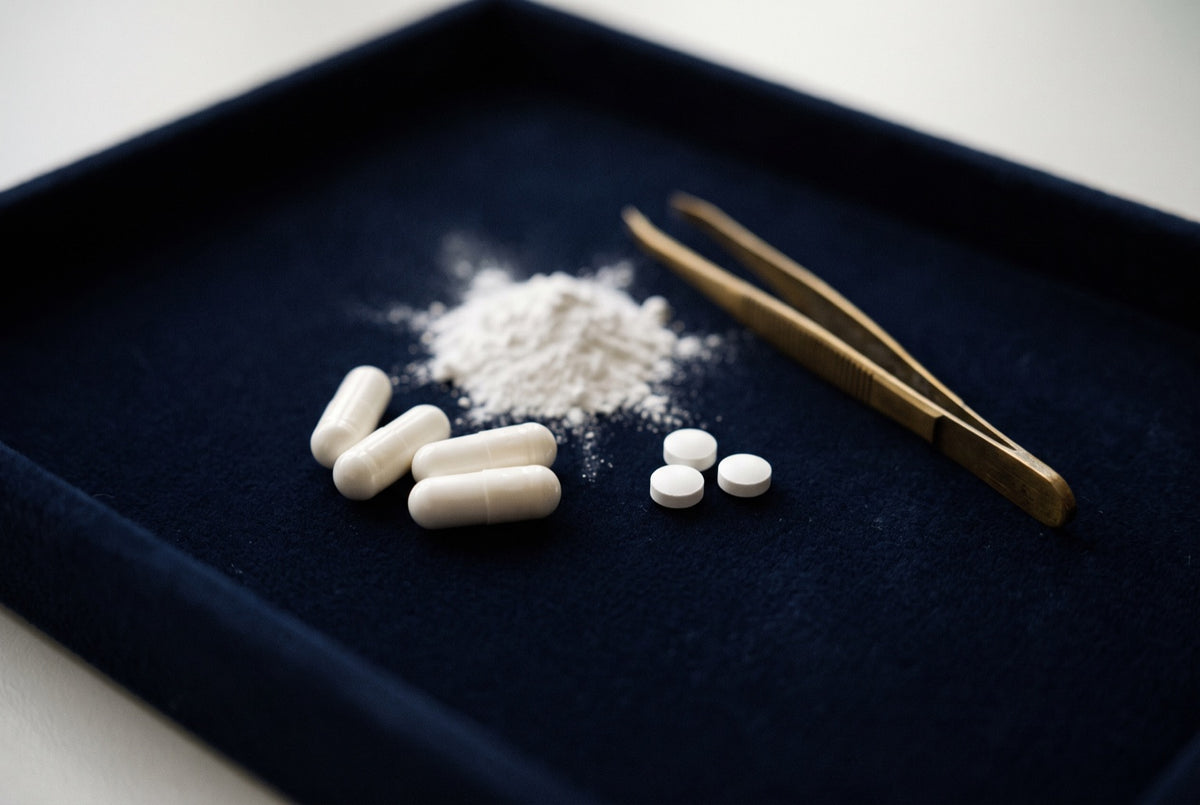
Liposomal NMN has not been shown to work better than regular NMN. The only head-to-head human study we found gave liposomal NMN to five men and saw higher blood NAD+ after four weeks. That's an interesting start, and a long way from proof. Meanwhile, the larger trials that raised blood NAD levels used plain NMN, swallowed as a capsule or tablet. So before you pay extra for a delivery upgrade, here's what each format (capsule, powder, liposomal and sublingual) actually has behind it.
NMN (nicotinamide mononucleotide) is a building block your body uses to make NAD+, a coenzyme involved in cellular energy metabolism. Some trials measure NAD+ alone; others measure total NAD, which is NAD+ plus its reduced form, NADH. That's why you'll see both terms below. If you want the basics first, our NMN supplement guide covers what NMN is and what the trials measured. This post sticks to one question: does the form you buy change what you get?
The short answer
- Liposomal NMN: one small study (five people per group) favored it.
- Sublingual NMN: in a 14-man crossover trial, holding NMN under the tongue did not raise blood NMN or NAD+ more than swallowing it.
- Capsules and tablets: the format behind the randomized trials that raised blood NAD.
- NMN powder: the same ingredient without the shell. Your dose is only as accurate as your scoop.
- "Pure" NMN: the word means little on its own. Look for GMP manufacturing, third-party testing and a batch certificate of analysis.
Is liposomal NMN better than regular NMN?
Not on current evidence. The one direct comparison is a 2025 exploratory study by Kawakami and colleagues. Fifteen healthy men aged 40 and over were split into three groups of five. One group took liposomal NMN, one took regular NMN (350 mg a day each) and one took a maltodextrin placebo. Everyone took it after breakfast for four weeks. At the four-week mark, blood-cell NAD+ in the liposomal group was significantly higher than in both other groups.
Two details keep that result in the "promising" column rather than the "settled" one. First, five people per group is very small. Second, the liposomal product was supplied free by its maker, while the regular NMN was a different company's product, so the study compared two specific products as much as two formats. Notably, the regular NMN in that study did not differ significantly from placebo at four weeks (p = 0.545), even though larger trials of ordinary NMN have raised blood NAD repeatedly.
Those larger trials are where most of the NMN evidence lives. A 2026 systematic review and meta-analysis included 15 randomized controlled trials: 12 used ordinary free NMN and three used a microcrystalline NMN-related preparation called MIB-626. The human evidence for NMN is built on the plain ingredient.
What does "liposomal" mean for NMN?
What is liposomal NMN? It's NMN packed inside liposomes: tiny vesicles made of phospholipid layers wrapped around a watery core. A review of oral liposome delivery describes liposomes as structures that mimic natural cell membranes, with an inner water phase that can carry water-loving ingredients. The Kawakami team describes entrapping NMN this way in the liposomal NMN supplement they studied. For the full science, see how liposomal supplements work.
The pitch is protection plus a shortcut. The liposome is supposed to shield NMN through digestion and then fuse with the cells lining the gut, delivering NMN inside intact instead of letting it take the usual conversion route. The Kawakami authors propose exactly that membrane-fusion route in their paper. It is a proposed mechanism, not something measured in people.
Digestion is the real test, and good formulation work is designed to pass it. The same review explains that conventional liposomes are vulnerable to stomach acid, bile salts and pancreatic enzymes. Some are broken open and leak their cargo, while others survive into the small intestine. Formulators improve stability by adjusting the lipid layers and adding protective coatings. That's why results belong to a specific finished formula, and for liposomal NMN the human record so far is one small study.
What do capsule and powder NMN studies show?
Plain oral NMN has the deepest human record, and in the two placebo-controlled trials below it raised NAD in blood.
- Dose-ranging capsules. Blood NAD rose in every NMN group in a 2023 randomized, double-blind trial (Yi et al.). The trial enrolled 80 healthy adults aged 40 to 65. They took placebo or 300, 600 or 900 mg of NMN once daily for 60 days, as 150 mg capsules. The rise was significant at days 30 and 60 (all p ≤ 0.001) and highest at 600 and 900 mg. NMN was well tolerated, and six-minute walking distance improved as a secondary outcome.
- Twelve weeks of tablets. In a 2022 placebo-controlled trial (Okabe et al.), 30 healthy adults aged 20 to 65 took 250 mg of NMN a day (two 125 mg tablets) or placebo for 12 weeks. Whole-blood NAD+ rose significantly, with no abnormal physiological or laboratory findings.
- Single doses. A 2020 study in 10 healthy men (Irie et al.) gave single oral doses of 100, 250 and 500 mg. None caused significant clinical symptoms or vital-sign changes, and the NMN breakdown products 2PY and 4PY rose in blood in step with the dose, a sign the body absorbed and processed it.
- The big picture on tolerability. The 2026 meta-analysis covered doses from 250 to 2,000 mg a day for 14 days to 24 weeks. NMN did not increase overall, serious or withdrawal-related adverse events. It also did not significantly raise the liver enzymes ALT or AST.
NMN powder vs capsules
A tub labeled "pure NMN powder" holds the same molecule you'll find in NMN capsules, minus the shell. The real difference is dose control: a capsule delivers the same amount every time, while powder delivers whatever your scoop holds. Powder suits people who want to adjust the amount or would rather not swallow capsules. If that's you, use the scoop the label specifies, level it, and check how many milligrams one scoop provides.
Does sublingual NMN absorb better?
Not in the first direct test. A 2026 randomized crossover trial (Wakabayashi et al.) enrolled 14 healthy men aged 20 to 35, and 13 completed both routes. Each took a single 250 mg β-NMN tablet two ways, eight days apart. Once they held it under the tongue for three minutes; once they swallowed it with water. Over 60 minutes of blood sampling, blood levels of NMN, nicotinamide and NAD+ did not differ significantly between the two routes.
What did rise faster after the under-the-tongue dose were 2PY and 4PY, the end products the body makes when it breaks NMN down. The authors could not tell where that extra early rise came from. The theory behind sublingual NMN is that it skips the liver's first pass; the first human test found no blood NAD+ advantage in that first hour. It was one dose, one hour and young men only, so the question stays open. For now, there's no evidence-based reason to pay more for an under-the-tongue routine.
NMN forms compared
| Form | Human evidence | Dose control | What to check on the label |
|---|---|---|---|
| Capsule or tablet | Randomized trials at 250 to 900 mg a day raised blood NAD or NAD+ (Yi 2023, Okabe 2022) | Fixed amount per capsule or tablet | Milligrams of NMN per capsule, capsules per serving, servings per bottle |
| Powder | Same ingredient as capsules, without the shell | Depends on the scoop and how you measure | Milligrams per level scoop, whether a scoop is included, servings per container |
| Liposomal (capsule or liquid) | One 15-person study favored a liposomal product over another brand's regular NMN (Kawakami 2025) | Fixed per capsule; measured for liquids | NMN milligrams listed separately from the liposome ingredients, the phospholipid source, capsules per serving |
| Sublingual (powder or tablet) | One 14-person crossover found no difference in blood NMN or NAD+ versus swallowing (Wakabayashi 2026) | Fixed for tablets; scoop-dependent for powder | Milligrams per tablet or scoop, and how long to hold it under the tongue |
The pattern is clear: the form you pick mostly changes convenience and dose control. The deepest research sits with plain NMN taken by mouth.
What does "pure NMN" mean on a label?
"Pure" is a label word, not a lab result. What gives it meaning is testing you can check. The NIH Office of Dietary Supplements explains that manufacturers must follow good manufacturing practices (GMPs). It adds that seals from independent testing organizations indicate a product was properly made, contains the listed ingredients and has no harmful levels of contaminants. Those seals do not guarantee that a product is safe or effective. They confirm what's in the bottle.
So look for three things: GMP manufacturing, third-party testing and a certificate of analysis (COA) for the lot you're buying. A brand that tests its batches can share that COA when you ask. Infinite Labs makes its certificates of analysis available on request.
You'll also see "β-NMN" (beta-NMN) on labels. That is the form named in the research, including the Yi trial and the sublingual crossover, which reported its crystalline NMN at 99.9% purity for the lot used. That's what a purity statement looks like when it's backed by paperwork: a number tied to a batch. A retail COA does the same job for the bottle in your hand.
The regulatory picture is context, not a quality check. In a September 2025 response to a citizen petition, the FDA reversed its earlier conclusion that NMN was excluded from the dietary-supplement definition. In plain terms, the drug-exclusion rule no longer keeps NMN out of supplements. It is not an FDA approval of any product, dose or purity claim. NMN products still have to meet the usual supplement rules.
Where our NMN capsule fits
Straight answer first: Infinite Labs NMN is not liposomal and not sublingual. It's a standard veggie capsule with 500 mg of NMN in each hypromellose (plant cellulose) capsule. Besides the capsule itself, the formula adds Nu-FLOW, a rice-hull-derived flow aid that helps keep the powder from clumping during capsule filling. Adults take one capsule daily with food, or as recommended by a qualified healthcare professional, and each bottle holds 60 servings.
For most people weighing these formats, that makes it a strong pick. You get plain NMN swallowed by mouth, the form the trial evidence is built on, at a fixed 500 mg dose with no scoop to level and no timer under the tongue. A 500 mg daily serving also sits inside the 250 to 2,000 mg range used across the randomized trials in the 2026 meta-analysis. The capsule is third-party tested and made in GMP-certified facilities, and certificates of analysis are available on request.
If you're pregnant or breastfeeding, take prescription medicines or manage a health condition, check with your clinician before adding NMN or any new supplement.
Quick answers
What are the benefits of taking liposomal NMN?
The benefit claimed for liposomal NMN is better delivery, and so far one 15-person study supports it. The benefits researchers have actually measured for NMN, chiefly higher NAD in blood, come mostly from trials of regular, non-liposomal NMN.
What happens if you take NMN every day?
Daily use is exactly what the trials tested. Across randomized trials lasting 14 days to 24 weeks at 250 to 2,000 mg a day, the 2026 meta-analysis found no increase in adverse events and no significant rise in liver enzymes. Studies longer than six months are still needed. For what trials recorded and why some people stop, see our guide to NMN side effects.
Is NMN really worth the hype?
It's worth it if your expectations match the evidence. The solid human finding is that NMN raises NAD in blood. Functional results are smaller and mixed. In the Yi trial, walking distance improved as a secondary outcome. The 2026 meta-analysis found no significant effects on body weight, fasting glucose, HbA1c or blood lipids. It did find a small drop in diastolic blood pressure. Our article on what NMN human trials actually measured walks through each result.
The takeaway
Format matters less than dose, quality and consistency. Liposomal and sublingual NMN are interesting delivery ideas with very small studies behind them so far, while plain NMN by mouth has the deepest trial record. Pay for evidence, not adjectives: check the milligrams per serving, ask for the batch COA and choose a format you'll take every day. If a fixed-dose capsule suits you, Infinite Labs NMN gives you 500 mg in one veggie capsule a day.
Sources
- Kawakami S, Maeda Y, Fukuzawa Y. Intervention study comparing blood NAD+ concentrations with liposomal and non-liposomal nicotinamide mononucleotide. Ann Clin Med Case Rep, 2025.
- Yi L et al. The efficacy and safety of β-nicotinamide mononucleotide (NMN) supplementation in healthy middle-aged adults. GeroScience, 2023.
- Okabe K et al. Oral administration of nicotinamide mononucleotide is safe and efficiently increases blood NAD+ levels in healthy subjects. Frontiers in Nutrition, 2022.
- Irie J et al. Effect of oral administration of NMN on clinical parameters and nicotinamide metabolite levels in healthy Japanese men. Endocrine Journal, 2020.
- Wakabayashi J, Higashi S, Morifuji M. Sublingual NMN administration increases early circulating terminal catabolites 2PY and 4PY compared with oral administration in healthy adult men. Scientific Reports, 2026.
- Yang W et al. Safety and metabolism-related outcomes of oral NMN supplementation in adults: systematic review and meta-analysis. Nutrients, 2026.
- He H et al. Adapting liposomes for oral drug delivery. Acta Pharmaceutica Sinica B, 2019.
- U.S. FDA. Response to citizen petition FDA-2023-P-0872 on β-NMN, September 2025.
- NIH Office of Dietary Supplements: Dietary Supplements, What You Need to Know.
Educational information, not medical advice. Infinite Labs NMN is not intended to diagnose, treat, cure, or prevent any disease.


Keep it useful
Join the conversation