
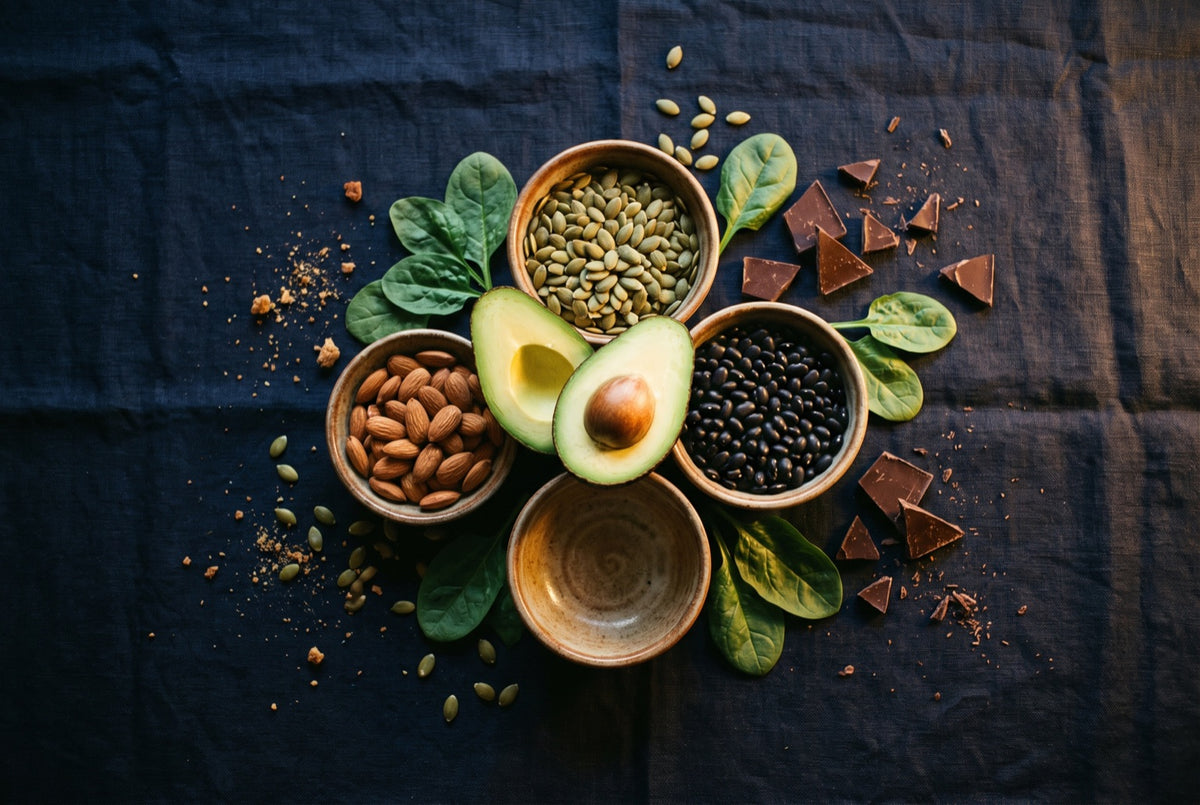
The foods with the most magnesium are seeds, nuts, leafy greens, beans and whole grains, and pumpkin seeds top the chart at 156 mg per ounce. Chia seeds (111 mg per ounce), almonds (80 mg per ounce), boiled spinach (78 mg per half cup) and cashews (74 mg per ounce) complete the top five in the NIH Office of Dietary Supplements food table, which draws on USDA data.
Most adults need 310 to 420 mg a day, so the winning move is stacking several of these foods across your meals, not hunting for one superfood.
Below you'll find the full ranked list with milligrams and % Daily Value, four strong sources the usual lists skip, a sample day that adds up to 370 mg, and the one number to watch if you also use a supplement. If you want the why before the what, start with what magnesium does in the body. This guide is the shopping list.
The short answer
- The top five per serving: pumpkin seeds (156 mg per ounce), chia seeds (111 mg), almonds (80 mg), boiled spinach (78 mg per half cup) and cashews (74 mg).
- Adults need 310 to 420 mg of magnesium a day in total, depending on age and sex.
- No single food gets you there, so stack seeds, nuts, beans, leafy greens and whole grains across your meals.
- The 350 mg daily upper limit applies only to supplements and medicines; magnesium from food does not count toward it.
What foods have the most magnesium?
Seeds and nuts win per serving, with leafy greens, legumes and whole grains close behind. NIH ODS names green leafy vegetables, legumes, nuts, seeds and whole grains as good sources, and notes that foods containing dietary fiber generally provide magnesium. These are the top 10 per typical serving:
- Pumpkin seeds, roasted, 1 oz: 156 mg (37% DV)
- Chia seeds, 1 oz: 111 mg (26% DV)
- Almonds, dry roasted, 1 oz: 80 mg (19% DV)
- Spinach, boiled, ½ cup: 78 mg (19% DV)
- Cashews, dry roasted, 1 oz: 74 mg (18% DV)
- Peanuts, oil roasted, ¼ cup: 63 mg (15% DV)
- Shredded wheat cereal, 2 large biscuits: 61 mg (15% DV)
- Soymilk, plain or vanilla, 1 cup: 61 mg (15% DV)
- Black beans, cooked, ½ cup: 60 mg (14% DV)
- Edamame, shelled, cooked, ½ cup: 50 mg (12% DV)
Pumpkin seeds are the quiet overachiever of the snack aisle: one ounce delivers more than a third of the Daily Value. NIH ODS notes that foods providing 20% or more of the DV count as high sources, while lower percentages still contribute to a healthy diet.
By that yardstick, only pumpkin seeds and chia clear the bar in a single serving, with almonds and spinach one point short. So the practical answer is a handful of seeds here and a scoop of beans there, rather than one heroic ingredient.
Magnesium-rich foods: How much does a serving provide?
Here is the complete NIH list of 30 foods, highest to lowest per serving. The % Daily Value is based on the 420 mg DV for adults and children 4 years and older.
| Food | Serving | Magnesium (mg) | % DV |
|---|---|---|---|
| Pumpkin seeds, roasted | 1 oz | 156 | 37 |
| Chia seeds | 1 oz | 111 | 26 |
| Almonds, dry roasted | 1 oz | 80 | 19 |
| Spinach, boiled | ½ cup | 78 | 19 |
| Cashews, dry roasted | 1 oz | 74 | 18 |
| Peanuts, oil roasted | ¼ cup | 63 | 15 |
| Shredded wheat cereal | 2 large biscuits | 61 | 15 |
| Soymilk, plain or vanilla | 1 cup | 61 | 15 |
| Black beans, cooked | ½ cup | 60 | 14 |
| Edamame, shelled, cooked | ½ cup | 50 | 12 |
| Peanut butter, smooth | 2 tablespoons | 49 | 12 |
| Potato, baked with skin | 3.5 oz | 43 | 10 |
| Brown rice, cooked | ½ cup | 42 | 10 |
| Yogurt, plain, low fat | 8 oz | 42 | 10 |
| Breakfast cereal fortified with 10% DV magnesium | 1 serving | 42 | 10 |
| Oatmeal, instant | 1 packet | 36 | 9 |
| Kidney beans, canned | ½ cup | 35 | 8 |
| Banana | 1 medium | 32 | 8 |
| Milk | 1 cup | 27 | 6 |
| Salmon, Atlantic, farmed, cooked | 3 oz | 26 | 6 |
| Halibut, cooked | 3 oz | 24 | 6 |
| Raisins | ½ cup | 23 | 5 |
| Whole-wheat bread | 1 slice | 23 | 5 |
| Avocado, cubed | ½ cup | 22 | 5 |
| Chicken breast, roasted | 3 oz | 22 | 5 |
| Ground beef, 90% lean, pan broiled | 3 oz | 20 | 5 |
| Broccoli, chopped and cooked | ½ cup | 12 | 3 |
| White rice, cooked | ½ cup | 10 | 2 |
| Apple | 1 medium | 9 | 2 |
| Carrot, raw | 1 medium | 7 | 2 |
A few patterns jump out. Plant foods own the top of the list. Meat, fish and dairy sit lower per serving: 3 ounces of roasted chicken breast has 22 mg, 90% lean ground beef has 20 mg and a cup of milk has 27 mg (NIH ODS).
Fruit and most non-leafy vegetables are modest too. Bananas get plenty of magnesium hype, but one medium banana has 32 mg, or 8% of the DV, about a fifth of what an ounce of pumpkin seeds delivers.
Treat every number as an average, since brands and preparation methods differ. Food labels won't always help: the FDA only requires magnesium on a label when it has been added to the food (NIH ODS). For anything not on this list, USDA FoodData Central is the place to look up a close match.
What other foods contain magnesium?
The NIH table is a starting point, not the whole pantry. USDA FoodData Central lists several other strong sources that rarely make the listicles. USDA reports nutrients per 100 grams, so we converted them to everyday portions using USDA's own portion weights. The per-portion column is our approximate calculation.
| Food | Per 100 g | Everyday portion | Approx. per portion |
|---|---|---|---|
| Swiss chard, boiled | 86 mg | ½ cup chopped (about 88 g) | About 75 mg (18% DV) |
| Firm tofu, made with calcium sulfate | 58 mg | ½ cup (126 g) | About 73 mg (17% DV) |
| Dark chocolate, 70–85% cacao | 228 mg | 1 oz (28 g) | About 65 mg (15% DV) |
| Quinoa, cooked | 64 mg | ½ cup (about 93 g) | About 59 mg (14% DV) |
Swiss chard behaves a lot like spinach: cooked down, half a cup carries roughly 75 mg. Firm tofu is a strong pick for plant-based eaters, and quinoa edges past brown rice at about 59 mg versus 42 mg per half cup.
Then there's dark chocolate. At 228 mg per 100 g, it is a genuinely rich source, which may be the most popular fact in this article. It is still chocolate, though, so an ounce is the portion that keeps the math honest.
How much magnesium do you need a day?
Adult men need 400 to 420 mg of magnesium a day and adult women need 310 to 320 mg, according to the NIH Recommended Dietary Allowances. Pregnancy raises the target to 350 to 360 mg for adults (400 mg for pregnant teens). These totals cover everything you eat and drink.
| Age | Male | Female | Pregnancy | Breastfeeding |
|---|---|---|---|---|
| 9–13 years | 240 | 240 | n/a | n/a |
| 14–18 years | 410 | 360 | 400 | 360 |
| 19–30 years | 400 | 310 | 350 | 310 |
| 31–50 years | 420 | 320 | 360 | 320 |
| 51+ years | 420 | 320 | n/a | n/a |
What does a 370 mg day of magnesium-rich food look like?
Here is a simple day built entirely from the NIH food table. No supplements, no specialty ingredients. The total is our own addition of the listed values.
| Meal | Food | Magnesium (mg) |
|---|---|---|
| Breakfast | Instant oatmeal, 1 packet | 36 |
| Breakfast | Banana, 1 medium | 32 |
| Morning snack | Almonds, dry roasted, 1 oz | 80 |
| Lunch | Black beans, cooked, ½ cup | 60 |
| Lunch | Brown rice, cooked, ½ cup | 42 |
| Dinner | Spinach, boiled, ½ cup | 78 |
| Evening snack | Low-fat plain yogurt, 8 oz | 42 |
| Total | Seven foods | 370 |
That 370 mg clears the 310 to 320 mg target for adult women and lands about 50 mg short of the 420 mg target for men 31 and older. One swap closes the gap: trade the almonds for an ounce of pumpkin seeds and the day climbs to about 446 mg.
Eating plant-based? Swap the yogurt for a cup of soymilk and the original day reaches about 389 mg. Both totals are our calculations from the NIH values.
What drink is high in magnesium?
Soymilk is the standout everyday drink, with 61 mg per cup (15% DV), more than double the 27 mg in a cup of cow's milk (NIH ODS). Water can be a surprise contributor too. Tap, mineral and bottled waters range from 1 mg to more than 120 mg of magnesium per liter, depending on the source and brand (NIH ODS).
So a liter of a mineral-rich water can supply more than a serving of almonds, while a low-mineral water adds almost nothing.
To see where your water lands, check the mineral analysis on a bottled or mineral water label, or ask your water supplier for its mineral content.
How well is magnesium from food absorbed?
Your body absorbs roughly 30% to 40% of the magnesium in food and drinks, according to NIH ODS. The numbers in the tables above describe what's on the plate, not what your body takes in, which is one more reason to build your intake from several sources.
Processing matters as well. Refining grains in ways that remove the nutrient-rich germ and bran substantially lowers their magnesium content (NIH ODS). The table shows it plainly: half a cup of cooked brown rice has 42 mg, while the same amount of white rice has 10 mg. Choosing whole grains is one of the easiest upgrades on this page.
Good news for anyone piling on greens and seeds: magnesium from food does not pose a risk to healthy people, because the kidneys eliminate the excess in urine. The adult upper limit of 350 mg a day applies to magnesium from supplements and medicines, not to food (NIH ODS).
Who has trouble getting enough?
Nearly half of Americans fall short. An analysis of NHANES 2013–2016 data found that 48% of Americans of all ages get less magnesium from food and beverages than their Estimated Average Requirement, the intake that meets the needs of half of healthy people.
Men 71 and older and adolescent boys and girls are the most likely to have low intakes (NIH ODS). An earlier NHANES analysis (2003–2006) put average food intake at 268 mg for men and 234 mg for women who did not take magnesium-containing supplements, well under the adult RDAs above.
Some groups are more likely to run low because they absorb less or lose more, according to NIH ODS:
- People with gastrointestinal diseases such as Crohn's disease or celiac disease, where chronic diarrhea and fat malabsorption can deplete magnesium over time.
- People with type 2 diabetes or insulin resistance, who can lose more magnesium in their urine.
- People with alcohol dependence, through lower intake and higher losses.
- Older adults, who tend to eat less magnesium, absorb less from the gut and excrete more through the kidneys with age.
If you fall into one of these groups, or take one of the medicines covered in the quick answers below, the food list is still your foundation, and your clinician can tell you whether your magnesium needs checking.
Quick answers
How do you get 100% of your daily magnesium?
Build each meal around at least one food from the top of the list: seeds or nuts at breakfast or as a snack, beans or whole grains at lunch, leafy greens at dinner. The sample day above hits about 370 mg, and one pumpkin-seed swap takes it past the 420 mg Daily Value (our calculations from NIH ODS values).
What depletes magnesium the most?
The main drains are certain medicines and health conditions. Proton pump inhibitors (PPIs) taken for a long time, typically more than a year, can cause low blood magnesium, and loop and thiazide diuretics can increase the magnesium lost in urine.
Gastrointestinal conditions with chronic diarrhea or malabsorption, type 2 diabetes and alcohol dependence also deplete stores (NIH ODS). Don't stop a prescribed medicine on your own; ask your prescriber whether your magnesium should be checked.
What are signs of magnesium deficiency?
Early signs include loss of appetite, nausea, vomiting, fatigue and weakness, according to NIH ODS. Those overlap with many other conditions, so they are not a reason to self-diagnose. Deficiency from diet alone is uncommon in healthy people because the kidneys limit how much magnesium they excrete.
As deficiency worsens, numbness, tingling and abnormal heart rhythms can appear, and those need prompt medical care. Blood tests also reflect total body magnesium poorly, which is why a clinician who can weigh lab results alongside your history should assess it.
When a supplement makes sense
Food comes first, and for many people a couple of swaps close the gap. The NIH frames it the same way: nutritional needs should be met primarily through diet, and supplements can help when that isn't possible through food alone (NIH ODS).
That fits you if your intake stays short despite your best efforts, if your diet rules out several top foods (a nut or seed allergy, for example), or if a clinician advises extra magnesium.
For that top-up, Infinite Labs Liposomal Magnesium+ is our pick. Each 10 mL serving (2 teaspoons) provides 200 mg of elemental magnesium from magnesium bisglycinate and gluconate in a liposomal liquid made with sunflower lecithin.
Shake the bottle, then stir one serving into water or juice daily, or take it as your healthcare professional directs. Each bottle holds 18 servings. It is third-party tested and made in GMP-certified facilities, and certificates of analysis are available on request.
Bisglycinate is the glycine-bound form often sold simply as glycinate. Our guide to what magnesium glycinate does covers it in depth, and the types of magnesium guide compares it with citrate, oxide and the rest.
One number to track: the adult upper limit of 350 mg a day covers magnesium from supplements and medicines such as antacids and laxatives, and food doesn't count toward it (NIH ODS). A 200 mg serving fits under that line on its own.
Add any other magnesium supplements, antacids or laxatives you use to that 200 mg and keep the total at or below 350 mg a day, unless a clinician directs otherwise; our guide to how much magnesium is too much has the full breakdown.
If you have kidney disease, take a diuretic or a long-term PPI, or use bisphosphonates or certain antibiotics, check with your clinician or pharmacist before starting, since magnesium can interact with these medicines and impaired kidneys clear it less well.
The practical takeaway
Magnesium is easy to find once you know where it lives: seeds, nuts, beans, leafy greens and whole grains. Five swaps add up fast (our calculations from the NIH ODS table):
- White rice to brown rice: about 32 mg more per half cup.
- Almonds to pumpkin seeds: about 76 mg more per ounce.
- Milk to soymilk: about 34 mg more per cup.
- Cooked broccoli to boiled spinach: about 66 mg more per half cup.
- An ounce of chia seeds stirred into oatmeal or yogurt: about 111 mg more.
If food still leaves you short, a measured top-up such as Magnesium+ can fill the gap. Just keep supplements and medicines together under 350 mg a day unless your clinician advises otherwise.
Sources
- NIH Office of Dietary Supplements: Magnesium, Fact Sheet for Health Professionals (updated January 6, 2026).
- USDA FoodData Central: Chocolate, dark, 70–85% cacao solids (FDC 170273).
- USDA FoodData Central: Chard, Swiss, cooked, boiled, drained, without salt (FDC 170401).
- USDA FoodData Central: Quinoa, cooked (FDC 168917).
- USDA FoodData Central: Tofu, raw, firm, prepared with calcium sulfate (FDC 172475).
This article is educational and is not medical advice. Infinite Labs Liposomal Magnesium+ is not intended to diagnose, treat, cure, or prevent any disease.
About the author
Arjun Sareen is CEO of Infinite Labs and Infinite Labs Digital and a contributor to the Infinite Labs Journal. This brand-owned guide provides educational information, not individual medical advice.

Keep it useful
Join the conversation