

For most intermittent fasters, plain creatine monohydrate stirred into water does not break a fast. Creatine isn't a carbohydrate, and in a controlled study of 24 men, 5 g doses of creatine on their own had no effect on blood insulin. The catch is what comes along for the ride. Flavored blends, gummies and a splash of juice can change the answer, and strict water-only, religious and pre-blood-test fasts play by their own rules. So the useful question is why you're fasting.
The short answer
- Plain creatine monohydrate is not a carbohydrate, and creatine alone left serum insulin unchanged in a controlled study of 24 men.
- Eating in a set window to time your calories? A scoop in water fits your fast.
- Flavored creatine, gummies, sweeteners and carb-heavy mixers can bring sugar or calories. Read the label.
- No human study has tested creatine's effect on autophagy or ketosis, so confident claims either way are guesses.
- Fasting before a blood test? Follow your clinician's instructions and mention that you take creatine.
Does creatine break a fast?
For time-restricted eating, where you eat inside a set window and skip calories outside it, plain creatine is an easy fit. The International Society of Sports Nutrition (ISSN) describes creatine as a naturally occurring non-protein amino acid compound, found mostly in red meat and seafood. It is not a sugar or a starch. Your liver and kidneys also make creatine every day from the amino acids arginine and glycine, so it is hardly a foreign substance to a fasting body.
The insulin data backs that up. In the Green study (1996), creatine taken by itself had no effect on serum insulin. The same creatine followed by 93 g of simple carbohydrate sent insulin sharply higher. The creatine was never the problem. The sugar was.
That's why the details around your scoop matter more than the scoop itself:
- Flavored powders and gummies can carry sugar, sweeteners or other calories. Check the Supplement Facts panel before you take them mid-fast.
- Mixers count. Juice, milk or a protein shake turns a plain scoop into a small meal.
- Strict fasts have their own rules. In a water-only or religious fast, anything you swallow besides water may count. Follow the rules of your fast and take creatine when eating is allowed.
What kind of fast are you doing?
"Fasting" covers everything from a 16:8 eating schedule to religious fasts, multi-day water fasts and the up-to-12-hour fast before lab work. Find your goal below.
| Why you're fasting | Plain creatine monohydrate in water | What to check |
|---|---|---|
| Time-restricted eating or calorie timing (for example, 16:8) | Fits the fast for most people. It isn't a carbohydrate, and creatine alone didn't raise insulin in a controlled study. | Flavored powders, gummies, sweeteners, or mixing it into juice, milk or a shake. |
| Keeping insulin low between meals | Creatine alone left serum insulin unchanged; adding 93 g of sugar raised it sharply. | Save carb-heavy mixers for your eating window. |
| Autophagy | Unknown. No human study has measured creatine's effect. | If autophagy is the whole point, take creatine in your eating window. |
| Ketosis | Not tested directly. Plain creatine isn't a carbohydrate source. | Sugar in flavored products. |
| Religious fast | Depends on your tradition; anything swallowed may count. | Your tradition's guidance. Take it when eating is permitted. |
| Before a blood test or procedure | Follow your clinician's instructions. A creatine drink is not water. | Tell your provider you take creatine; your body breaks it down into creatinine. |
| Extended water-only fast (several days) | No studies of creatine during multi-day fasts. | Plan supplements with your clinician. |
Does creatine spike insulin?
No, not on its own. In the Green study, 24 healthy men took 5 g of creatine in solution four times a day for five days. One group took creatine alone. The other took the same creatine followed, 30 minutes later, by 93 g of simple carbohydrate. Creatine alone had no effect on serum insulin. The creatine-plus-carb group saw insulin rise dramatically, and their muscle total creatine climbed 60% more than in the creatine-only group.
A follow-up from the same lab explains why. In a 1998 insulin-clamp study of 7 men, researchers infused insulin at four different rates alongside 12.4 g of creatine. Insulin boosted muscle creatine only at physiologically high or supraphysiological levels: total creatine rose by 4.5 and 8.3 mmol/kg dry muscle at the two highest rates. In plain terms, it takes a big insulin push, the kind a large carb dose delivers, to speed creatine into muscle. Creatine doesn't produce that push by itself.
So do you need the carbs? No. A 2025 review by an international panel of creatine researchers concludes that creatine monohydrate is effective with or without other nutrients. Carbs speed uptake in the short term, but there is limited evidence they lead to bigger gains in strength or body composition. A shortcut, not a requirement. (Green used a five-day loading protocol rather than a fast, but it measured insulin with and without carbs, which is the question fasters care about.)
Does creatine affect autophagy or ketosis?
Nobody knows, because nobody has tested it in people. When we searched the Europe PMC research database in October 2026, we found no human study of creatine and autophagy (the cell's recycling process), and no human fasting study of creatine and ketosis (burning fat-derived ketones for fuel). The few papers that turned up were cell or animal studies, or didn't test fasting at all. So when a supplement page or a video tells you creatine "protects autophagy" or "kicks you out of ketosis," that's a guess dressed as a fact.
What we can say comes from how the body handles creatine, and it is reasoning rather than a measured result. Creatine isn't a carbohydrate, and nearly 99% of ingested creatine monohydrate is either taken up by muscle or excreted in urine. That makes it an unlikely source of the glucose that would end ketosis. Flavored products with sugar are a different story.
If autophagy is the main reason you fast, take creatine in your eating window. You lose nothing, because timing isn't what makes creatine work.
Can you take creatine on an empty stomach?
Yes. Creatine monohydrate is absorbed very well with or without food. A 2011 review in Amino Acids notes that it is not degraded during normal digestion. A crossover study of 17 healthy young men compared 2 g of creatine in water with the same dose built into a protein-rich or a beta-glucan-rich food bar. Food slowed absorption fourfold (protein) and eightfold (beta-glucan), yet total exposure in the blood didn't change, and no creatine turned up in stool in any form. Taken in plain water, it just gets in faster.
For stomach comfort, the factor with data behind it is serving size. In a 28-day double-blind trial of 59 male soccer players, a single 10 g dose came with diarrhea in 55.6% of players, versus 28.6% when the same 10 g was split into two 5 g doses and 35.0% on placebo. The 5 g servings were no different from placebo. A single 3 to 5 g serving in plenty of water is the comfortable choice for a fasting window, and it matches the 3 to 5 g a day the ISSN lists for maintaining muscle creatine stores. For more on stomach comfort, see our guide to creatine and digestion.
Is it better to take creatine in your eating window?
It's a sensible default, not a rule. The 2025 creatine misconceptions review concludes that timing does not appear to be a limiting factor for training adaptations and that consistent daily intake is likely the most important variable. An earlier review titled "Creatine O'Clock" came to a similar place: whether timing changes results is unclear.
The eating window does offer one small perk. Taking creatine with carbohydrate, or carbohydrate and protein, has been reported to more consistently promote greater creatine retention, which fits the Green results. So if you break your fast with a meal or a shake, that's a natural home for your scoop. If you'd rather take it mid-fast with water before training, that works too. Pick the slot you'll actually repeat every day.
Fasting for a blood test or procedure?
Your clinician's instructions win, every time. MedlinePlus explains that if creatinine is measured as part of a comprehensive or basic metabolic panel (CMP or BMP), you may need to fast, meaning no eating or drinking, for up to 12 hours. It also advises telling your provider everything you take, because certain medicines and supplements can affect results, and not stopping any medicine unless your provider says so. If your instructions say nothing but water, a creatine drink doesn't qualify. Take it after the draw unless you're told otherwise.
Creatine deserves a specific mention. Your body breaks it down into creatinine: about 1 to 2% of muscle creatine is converted each day, and the kidneys clear it in urine. Creatinine is the marker labs use to estimate how fast your kidneys filter blood (eGFR), and MedlinePlus notes you may be asked to skip meat for 24 hours before a creatinine test because meat can temporarily raise levels. Tell the person ordering the test that you take creatine, and ask whether to pause it. Our guides explain how creatine affects creatinine tests and cover creatine safety and kidney labs in more detail.
How to fit plain creatine into a fasting routine
For fasters, unflavored creatine monohydrate keeps the decision simple. Monohydrate is also the most extensively studied form of creatine, with little to no evidence that newer forms are more effective. No "fasting-friendly" relabeling required.
Infinite Labs Creatine Monohydrate is exactly that: an unflavored powder with 5 g of creatine monohydrate per scoop and 60 servings per container. The ingredient panel is short: creatine monohydrate plus silicon dioxide, a flow aid that keeps the powder from clumping. If you track every calorie in your fasting window, the Supplement Facts panel on your container has the final word. One allergen note: the current label states that this product contains wheat, so it isn't a fit if you need to avoid wheat.
Three easy ways to slot it in:
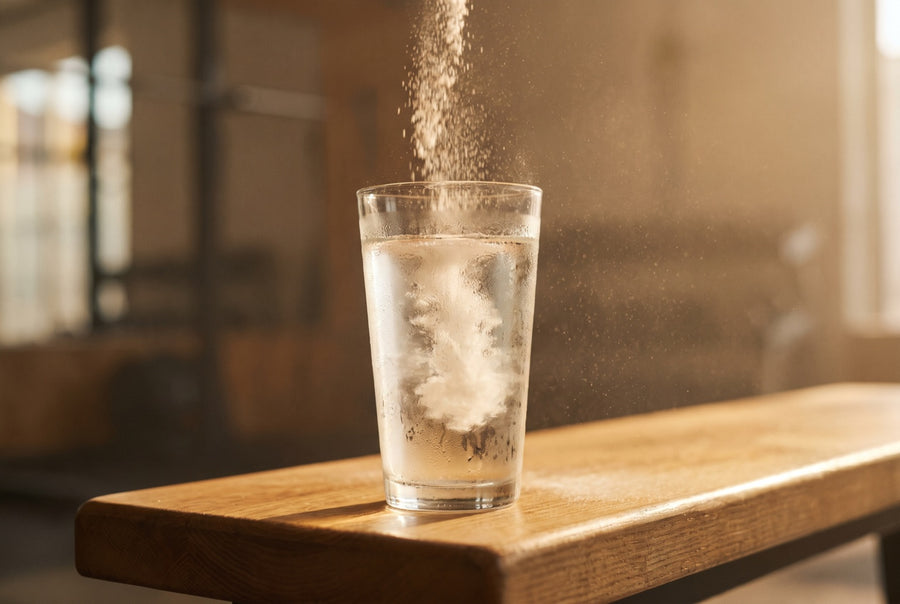
- During the fast: stir one scoop into at least 12 oz (360 mL) of room-temperature water, the minimum that creatine monohydrate's solubility of 14 g per liter at 20 °C allows for a 5 g scoop. Follow the mixing directions on your container. Our guide to how much water to drink on creatine covers the mixing glass and the rest of your day.
- Breaking the fast: add the scoop to your first meal or shake for the retention boost that comes with carbs and protein.
- Strict, religious or pre-lab fasts: take it in your eating window, or after the blood draw.
Mix it fresh. Creatine is stable as a powder, but the ISSN notes it slowly converts to creatinine once dissolved, faster in warm or acidic drinks, so skip batching bottles for the week. Certificates of analysis are available on request.
Quick answers
Does creatine break ketosis?
No study has tested it. Plain creatine monohydrate isn't a carbohydrate, so it isn't expected to supply the glucose that would end ketosis. Flavored products with sugar could matter, so check the label.
Does creatine mess up autophagy?
Unknown. There are no human studies, so confident answers in either direction are guesses. If autophagy is your goal, take creatine in your eating window.
Will creatine upset my stomach if I haven't eaten?
Serving size is the factor with data. In the dose trial, 5 g servings matched placebo for stomach symptoms, while a single 10 g serving raised diarrhea reports. If a scoop bothers you on an empty stomach, take it with your first meal.
The takeaway
Match the answer to your fast. If you eat in a window to time your calories, a plain scoop of creatine in water fits right in: it isn't a carb, and on its own it didn't move insulin. If your fast is water-only, religious or before a blood test, follow those rules and take creatine when eating is allowed. Autophagy and ketosis are untested, so ignore anyone who sounds certain. Whatever you choose, 3 to 5 g a day, every day, matters more than the clock. New to the supplement? Start with what creatine monohydrate does.
Sources
- Green AL et al. Carbohydrate ingestion augments skeletal muscle creatine accumulation during creatine supplementation in humans. Am J Physiol. 1996.
- Steenge GR et al. Stimulatory effect of insulin on creatine accumulation in human skeletal muscle. Am J Physiol. 1998.
- Antonio J et al. Part II. Common questions and misconceptions about creatine supplementation. J Int Soc Sports Nutr. 2025.
- Candow DG et al. Creatine O'Clock: does timing of ingestion really influence muscle mass and performance? Front Sports Act Living. 2022.
- Kreider RB et al. ISSN position stand: safety and efficacy of creatine supplementation. J Int Soc Sports Nutr. 2017.
- Jäger R et al. Analysis of the efficacy, safety, and regulatory status of novel forms of creatine. Amino Acids. 2011.
- Deldicque L et al. Kinetics of creatine ingested as a food ingredient. Eur J Appl Physiol. 2008.
- Ostojic SM, Ahmetovic Z. Gastrointestinal distress after creatine supplementation in athletes: are side effects dose dependent? Res Sports Med. 2008.
- MedlinePlus: Creatinine Test.
- NIH ODS: Dietary Supplements for Exercise and Athletic Performance (Health Professional).
Educational information, not medical advice. Infinite Labs Creatine Monohydrate is not intended to diagnose, treat, cure, or prevent any disease.
Keep it useful
Join the conversation