
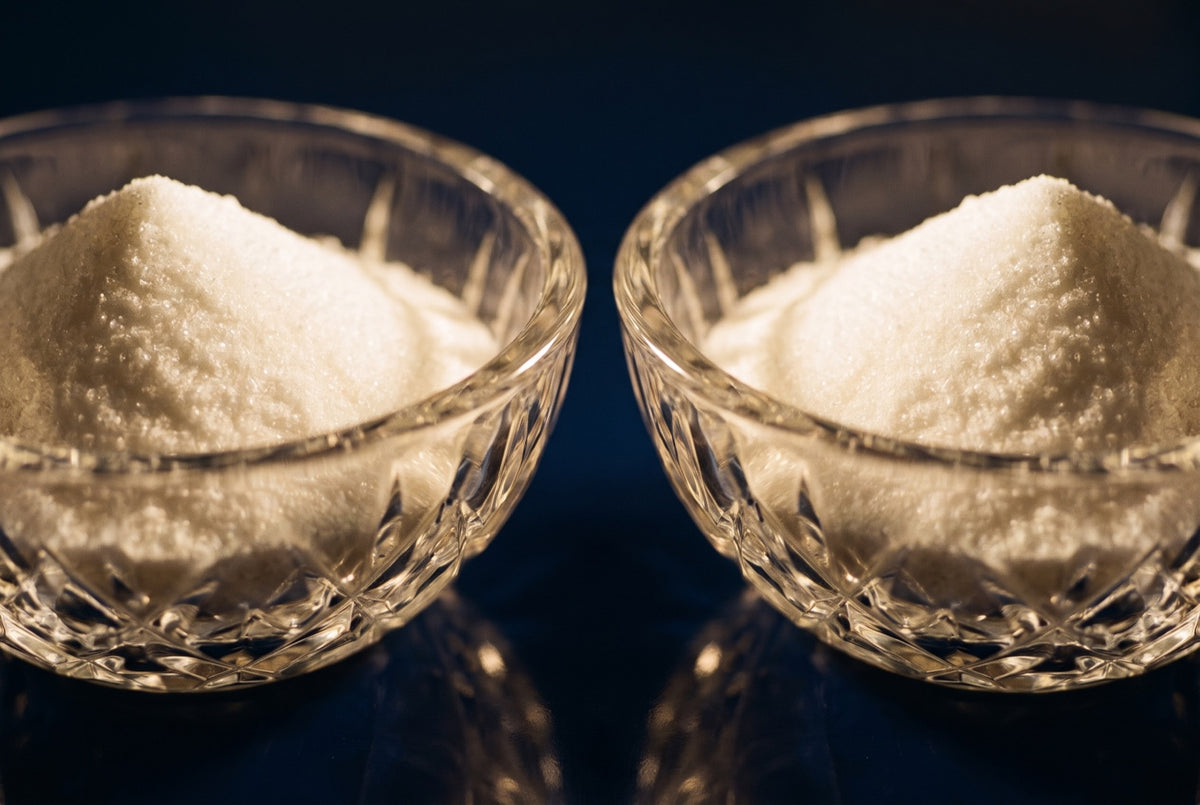
Yes: magnesium bisglycinate and magnesium glycinate are the same compound, sold under two names. Both describe one magnesium atom bound to two glycine molecules, and the PubChem record for magnesium glycinate (CID 84645) lists “magnesium bisglycinate” and “magnesium diglycinate” as synonyms of that single entry. The “bis” just counts the glycines. What really changes from bottle to bottle is the amount of elemental magnesium per serving, whether glycinate is the only form in the formula, and the format you take it in.
So if you have two labels open and suspect the “bis” version is the premium one, relax. The prefix is chemistry's way of counting to two, not a quality tier. Below: where the names come from, the label details that do differ, the dose math a front label leaves to you, and the medicines worth a quick pharmacist check. For what this form of magnesium does in the body, see our guide to what magnesium glycinate does.
The short answer
- Same compound: PubChem files magnesium bisglycinate, diglycinate and glycinate under one record.
- “Bis” means two: one magnesium, two glycines.
- Pure magnesium glycinate is about 14% magnesium by weight (our calculation), so the Supplement Facts number matters more than the compound weight.
- Check whether glycinate is the only magnesium form or part of a blend.
- Adults: keep magnesium from supplements and medicines at or under 350 mg a day unless a clinician advises otherwise.
Is magnesium bisglycinate the same as magnesium glycinate?
Yes. PubChem, the chemistry database run by the U.S. National Library of Medicine, files both names under one compound: CID 84645, formula C4H8MgN2O4. Its synonym list includes magnesium bisglycinate, magnesium diglycinate, bis(glycinato)magnesium and “Magnesium glycinate [USAN]”, and a name search for “magnesium bisglycinate” lands on the same record. Different words, same molecule.
Could plain “glycinate” mean a different ratio, say one glycine instead of two? Not by the official naming. “Magnesium glycinate” is the United States Adopted Name (USAN) for this ingredient, and PubChem attaches that USAN tag to the same two-glycine record. A label that says glycinate and a label that says bisglycinate are naming the same compound. One of them just spells out the structure.
Where the two names come from
Both names come straight from chemical naming. PubChem gives the compound's systematic name as magnesium bis(2-aminoacetate). Glycine's own systematic name is 2-aminoacetic acid; once it gives up a hydrogen and bonds to a mineral, it is called glycinate, or 2-aminoacetate. “Bis” is the chemistry prefix for two, and “di” means two as well. That is why bisglycinate and diglycinate sit on the same record as plain glycinate: three spellings of one magnesium paired with two glycinates.
| Label term | What it means |
|---|---|
| Magnesium | The mineral itself, and the part the Supplement Facts amount counts. |
| Bis- or di- | Two: one magnesium partners with two glycinates. |
| Glycinate | The amino acid glycine in the form it takes when bonded to the mineral. |
| C4H8MgN2O4 | The formula: one magnesium plus two glycinate units. |
| 172.42 | The molecular weight of the whole compound (g/mol). |
That molecular weight is where the label math starts. Magnesium has an atomic mass of 24.305, so pure magnesium glycinate is about 14.1% magnesium by weight (our calculation: 24.305 ÷ 172.42). The other 86% or so is the glycine part. Hold on to that ratio; it comes back when we get to doses.
What can actually differ between products?
Because the molecule is the same, every meaningful difference between two “glycinate” products lives on the label. Run this four-point check before you buy:
- Elemental magnesium per serving. The NIH Office of Dietary Supplements (ODS) explains that the Supplement Facts panel declares elemental magnesium, not the weight of the whole compound. That number, not the front-label milligrams, is your dose.
- Every magnesium form in the formula. Some products use glycinate alone; others pair it with a second form, such as bisglycinate plus gluconate. Front-label words like “buffered” don't tell you which forms are inside. The ingredient list does: if it names oxide, citrate or another salt beside glycinate, you are looking at a blend. A blend is a formulation choice, not a red flag, as long as the label states it plainly. Our guide to other forms of magnesium explains what each one is.
- Format. Capsule, tablet, powder or liquid changes the serving size and how the product fits your day. “Liposomal” describes a delivery format built from lipid structures, not the magnesium compound inside; here is what liposomal means.
- Everything else on the panel. Serving size, servings per container, flavors, sweeteners and any added ingredients vary between brands. Compare them the way you would for any two supplements.
Does one absorb better or work better?
Neither, because there is only one compound. No trial compares bisglycinate with glycinate, since that would be testing a molecule against itself. The useful question is how glycinate compares with other magnesium forms, and there the human studies are few and small.
In a 1994 double-blind crossover trial, 12 patients who had part of the small intestine (the ileum) removed each took a 100 mg dose of isotope-labelled magnesium, once as diglycinate and once as oxide. Across the group, absorption was nearly identical: 23.5% versus 22.8%. In the four patients who absorbed oxide worst, diglycinate came out well ahead at 23.5% versus 11.8%, and patients tolerated it better.
A 2003 randomized, double-blind trial gave 46 healthy adults 300 mg of elemental magnesium a day for 60 days as an amino-acid chelate, citrate or oxide, against placebo. Citrate and the chelate showed greater absorption than oxide on 24-hour urinary magnesium, and citrate produced the highest mean serum magnesium. The study describes that form only as an amino-acid chelate.
ODS sums up the wider picture: forms that dissolve well in liquid are absorbed more completely, and small studies found aspartate, citrate, lactate and chloride more bioavailable than oxide and sulfate. Glycinate isn't ranked on that list. If you are choosing between glycinate and a genuinely different salt, our magnesium glycinate vs citrate comparison covers it. And if a bisglycinate product and a glycinate product feel different to you, look at the dose, the other forms in the blend and the rest of the formula. The name can't be the reason.
How much elemental magnesium are you getting?
Here is the math a front label leaves to you. Say a bottle advertises “1,000 mg magnesium bisglycinate.” At 14.1% magnesium, that is roughly 141 mg of elemental magnesium (our calculation, assuming the 1,000 mg is pure compound). A big number on the front can be a modest dose on the back.
| Compound weight | Elemental magnesium (approx.) | For context |
|---|---|---|
| 710 mg | 100 mg | A round 100 mg serving |
| 1,000 mg | 141 mg | The worked example above |
| 1,775 mg | 250 mg | The daily dose in a 2025 bisglycinate sleep trial |
| 2,480 mg | 350 mg | The adult upper limit for supplemental magnesium |
The good news: you rarely need a calculator. Because the Supplement Facts panel lists elemental magnesium, as the ODS fact sheet notes, read the front label for the form and the back label for the dose. That back-label number is the one to compare with the targets.
ODS lists a recommended dietary allowance for adults of 310 to 420 mg a day from all sources, depending on age and sex, and an upper limit of 350 mg a day for adults from supplements and medicines. Magnesium in food doesn't count toward that limit. High doses from supplements can cause diarrhea, nausea and abdominal cramping; our guide to how much magnesium is too much covers the details.
Who should not take magnesium bisglycinate?
The same people who should be careful with any magnesium supplement, since the compound is the same. Check with your doctor or pharmacist first if any of these apply (all from the ODS fact sheet):
- Kidney disease or reduced kidney function. The kidneys clear excess magnesium, so the risk of magnesium toxicity rises when they can't.
- Oral bisphosphonates for osteoporosis, such as alendronate. Magnesium can reduce their absorption; take the two at least 2 hours apart.
- Tetracycline or quinolone antibiotics, such as doxycycline, ciprofloxacin or levofloxacin. Take the antibiotic at least 2 hours before or 4 to 6 hours after magnesium.
- Diuretics. Loop and thiazide diuretics such as furosemide and hydrochlorothiazide increase magnesium loss in urine; potassium-sparing types such as spironolactone reduce it. Either way, talk through your magnesium intake with your prescriber.
- Proton pump inhibitors taken long term (typically more than a year), such as esomeprazole or lansoprazole, which can cause low blood magnesium.
What about Paxil (paroxetine) or rosuvastatin? Neither appears in the ODS interaction section, but ODS presents that section as a few examples, so a missing name isn't a green light. Rosuvastatin's prescribing information, for instance, says to take the statin at least 2 hours before an aluminum and magnesium hydroxide antacid. That is an antacid, not a glycinate supplement, but it is exactly the kind of timing detail your pharmacist can check against your full medication list.
Quick answers
Is magnesium bisglycinate best for sleep?
It has a placebo-controlled sleep trial behind it, with a small effect. A 2025 randomized, placebo-controlled trial enrolled 155 adults aged 18 to 65 who reported poor sleep. Taking 250 mg of elemental magnesium as bisglycinate daily for four weeks lowered their Insomnia Severity Index scores by 3.9 points, versus 2.3 with placebo (p = 0.049, Cohen's d = 0.2). The trial didn't test other magnesium forms, so it shows a modest improvement rather than proving bisglycinate beats them.
Is chelated magnesium the same thing?
Magnesium glycinate is one kind of chelate; the 1994 absorption study above describes magnesium diglycinate that way. “Chelated magnesium” or “amino-acid chelate” on its own doesn't tell you which amino acid is involved, so look for the named compound in the ingredient list.
Can I take magnesium glycinate with other medicines?
Some need spacing. The ODS fact sheet advises keeping magnesium at least 2 hours away from oral bisphosphonates, and taking tetracycline or quinolone antibiotics at least 2 hours before or 4 to 6 hours after it. For anything else, including antidepressants and statins, ask your pharmacist.
Where Magnesium+ fits
Infinite Labs Liposomal Magnesium+ is a strong pick if you would rather drink your magnesium than swallow another capsule, and it makes a clean example of the label check above:
- Elemental magnesium: 200 mg per 10 mL serving (two teaspoons), stated as magnesium itself rather than compound weight. On its own that sits under the 350 mg adult limit for supplemental magnesium; add up any other magnesium you take.
- Magnesium forms: magnesium bisglycinate and magnesium gluconate, listed by name. It's a two-form blend, and it says so up front.
- Format: a liposomal liquid. Sunflower lecithin supplies the phospholipids used in the liposomal format.
- Serving and storage: 18 servings per bottle. Shake, then mix 10 mL into water or juice once a day, and use within 30 days of opening.
- Quality: third-party tested and made in GMP-certified facilities, and certificates of analysis are available on request.
The practical takeaway
Bisglycinate or glycinate, you are buying the same compound, so stop comparing names and compare labels. Check the elemental magnesium per serving, every magnesium form in the formula, a format you will actually take each day, and your medicines. Get those four right and the naming question answers itself.
Sources
- PubChem: Magnesium glycinate, CID 84645 (National Library of Medicine).
- PubChem: Glycine, CID 750.
- PubChem: Magnesium (element).
- NIH ODS: Magnesium, Fact Sheet for Health Professionals.
- Schuette et al. Magnesium diglycinate vs oxide after ileal resection. JPEN, 1994.
- Walker et al. Magnesium citrate vs other magnesium preparations. Magnesium Research, 2003.
- Schuster et al. Magnesium bisglycinate in adults reporting poor sleep. Nature and Science of Sleep, 2025.
- DailyMed: Crestor (rosuvastatin) prescribing information.
Educational information, not medical advice. Infinite Labs Liposomal Magnesium+ is not intended to diagnose, treat, cure, or prevent any disease.

Keep it useful
Join the conversation